The USS Abraham Lincoln is trending after a U.S. Navy sailor said his father was detained by federal immigration officials while the sailor remains deployed aboard the aircraft carrier.
The sailor, Joshua Aviles, said in a social-media post that he learned his father had been taken into Immigration and Customs Enforcement custody during the ship’s extended deployment in the Middle East. The Department of Homeland Security confirmed the detention to CBS News and said the man, Luis Manuel Aviles Roa, was arrested by Border Patrol during a traffic stop in Key West, Florida, on Saturday, August 22, 2026.
The story is gaining attention because it combines two separate national issues: the unusually long deployment of a major U.S. warship and the Trump administration’s immigration enforcement policies, including their effect on families connected to the military. The father’s detention has not been described by authorities as related to his son’s service.
What is confirmed about the detention
DHS said Aviles Roa, a Nicaraguan national, entered the United States illegally and remained in ICE custody while facing deportation proceedings. The department did not dispute the family’s claim that he has no criminal record.
Family members told CBS News that Aviles Roa had lived in the United States for about 20 years and had a pending application for legal status. Those details came from relatives and were not independently confirmed in the available reporting. A pending application does not necessarily prevent immigration authorities from making an arrest or placing someone in removal proceedings.
DHS said in a statement that having a family member in the military does not exempt a person from immigration law. The department characterized the case as enforcement of laws passed by Congress.
The available reports do not establish whether Aviles Roa’s pending application was active, whether he had any prior immigration orders, or what specific legal path his family was pursuing. Those details could affect the next steps in his case.
Why the sailor’s situation has drawn attention
Aviles said he had been deployed for more than nine months aboard the Lincoln. In his post, he described the emotional strain of learning that his father had been detained while he was working long days at sea.
His half-sister, Katty Delgado, told CBS News that communication with Aviles had been intermittent because he was deployed overseas. She said he was having trouble sleeping and eating and was focused on finding out where his father was and how he was being treated.
Those comments have resonated because military service often separates sailors from their families for months at a time. An arrest or detention involving a close relative can be difficult to address from a ship operating thousands of miles from home, even when the service member is not personally accused of wrongdoing.
The case is also part of a broader debate over immigration enforcement involving military families. CBS News reported that arrests of military spouses and parents, historically uncommon, have received increased attention since the administration rescinded earlier limits on immigration arrests by ICE and Border Patrol.
The carrier has been on an unusually long deployment
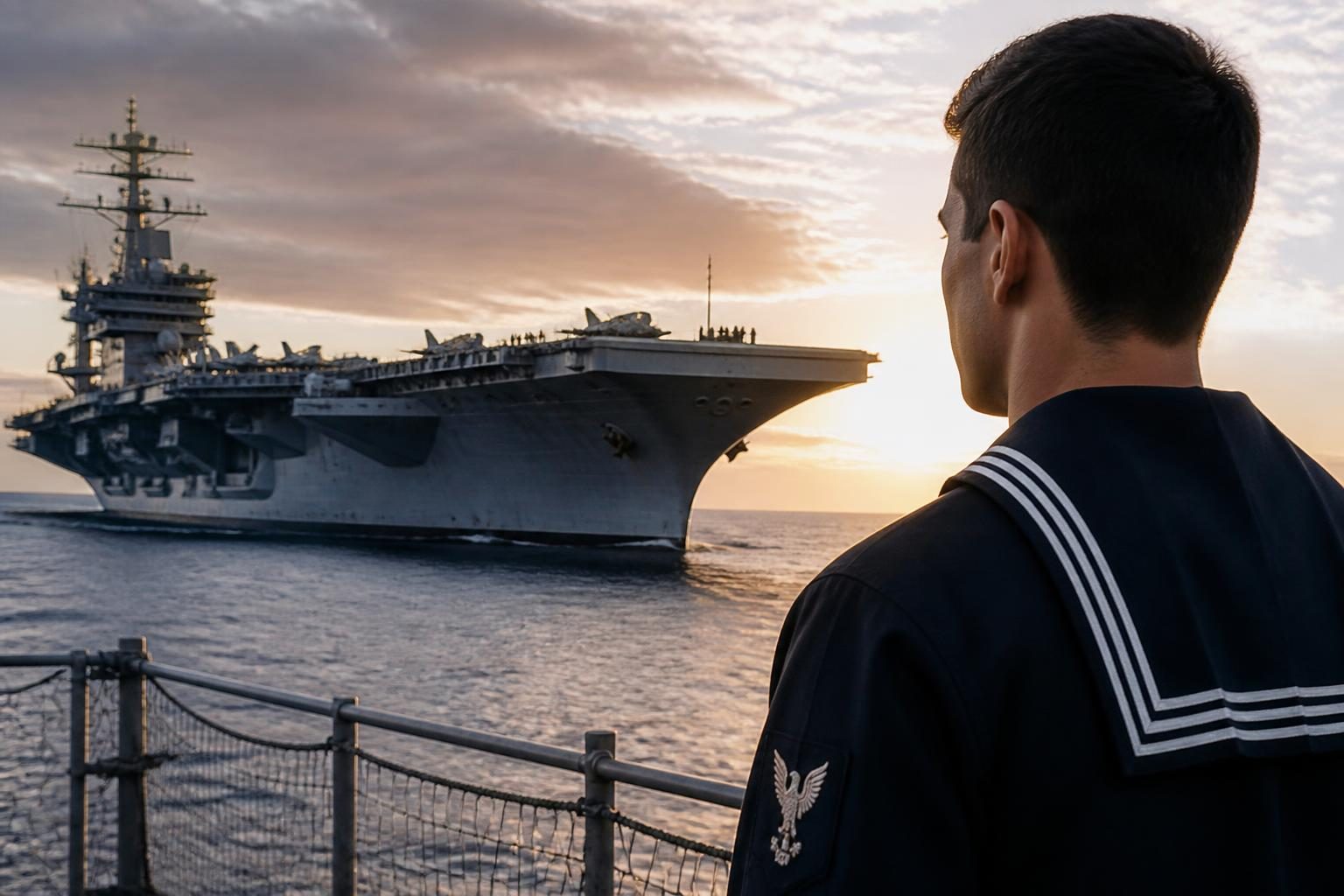
The USS Abraham Lincoln is a Nimitz-class nuclear-powered aircraft carrier homeported in San Diego. The Navy identifies it as CVN 72 and says it is the fifth Nimitz-class carrier. The ship was commissioned on November 11, 1989, and is named for the 16th president of the United States.
The carrier normally operates with a carrier strike group and an embarked air wing. The Navy describes aircraft carriers as central platforms for forward presence, sea control, deterrence, maritime security and air operations. The Lincoln can support dozens of aircraft and thousands of sailors and Marines.
In 2026, the carrier’s deployment was extended as U.S. forces conducted operations connected to the conflict with Iran. Public reports have described more than 240 days of uninterrupted time at sea and an overall deployment lasting more than 260 days. The exact figures have varied as the deployment continued and were later clarified in reporting.
The length of the mission has prompted reports from sailors’ families and others about mental-health concerns, supply shortages and difficult living conditions aboard the ship. The Navy has said it has not observed an increase in suicidal ideation or suicide attempts aboard the carrier, while declining to provide additional details because of patient privacy and operational-security concerns.
Those statements leave some issues unresolved. Reports about individual sailors’ experiences are not the same as a formal finding about the condition of the entire crew. At the same time, the Navy’s response does not by itself disprove every account from sailors or their families. A full assessment would require independent evidence and official reviews.
The Lincoln is heading home
The Navy has said the Lincoln will return to the United States as part of a planned rotation. On August 20, the Associated Press reported that the USS George Washington had arrived in the Middle East to relieve the long-deployed Lincoln.
The Lincoln left the region last week and is heading toward the United States. The trip could take several weeks, and public reports have not established the carrier’s exact arrival date or whether it will make a port call before returning to San Diego.
The changeover is significant for the crew because it marks the end of one of the longest and most demanding recent deployments by a U.S. aircraft carrier. It also gives the Navy an opportunity to evaluate the condition of sailors, address supply and maintenance needs, and provide post-deployment support.
What happens next in the immigration case
Aviles Roa is expected to remain in the immigration system unless authorities release him, grant bond, or otherwise change his custody status. The next steps may include an immigration-court hearing, a bond decision, an application for relief from removal, or a deportation order, depending on the facts of his case.
Immigration proceedings are civil rather than criminal proceedings. A person can be detained and placed in removal proceedings without being charged with a crime. The government still must apply the immigration laws and procedures that govern the person’s case.
The family’s statement that Aviles Roa had a pending application could become important if documentation shows that he had an unresolved request for lawful status or another form of protection. However, the existence of an application alone does not reveal its status or guarantee that the case will be approved.
Because Aviles is deployed, relatives and legal representatives may handle much of the communication with attorneys and authorities. The sailor’s military status may draw public attention to the case, but it does not determine the outcome of his father’s immigration proceedings.
What readers should keep in mind
- The detention is confirmed: DHS acknowledged that Aviles Roa was arrested by Border Patrol and held by ICE.
- The family’s account includes unverified details: Relatives said he had no criminal record, had lived in the United States for about 20 years and had a pending immigration application. Those claims require documentation or further independent confirmation.
- The sailor is not accused of misconduct: The reports concern his father’s immigration case, not an allegation against the sailor.
- The carrier’s long deployment is a separate issue: The Lincoln’s extended time at sea has generated reports about crew welfare, but the immigration detention did not cause the deployment or the ship’s return schedule.
- The final legal outcome is not yet known: Custody, bond and removal decisions can change as the case proceeds.
Bottom line
The USS Abraham Lincoln is in the news for two overlapping reasons: its sailors are returning from an exceptionally long Middle East deployment, and one sailor’s father has been detained by immigration authorities in Florida.
What is clear is that DHS has confirmed the arrest and that the Lincoln is heading home after being relieved in the region. What remains uncertain is the precise status of the father’s immigration application, whether he will be released from custody, and how the Navy will respond to ongoing concerns about the welfare of sailors after the carrier returns.