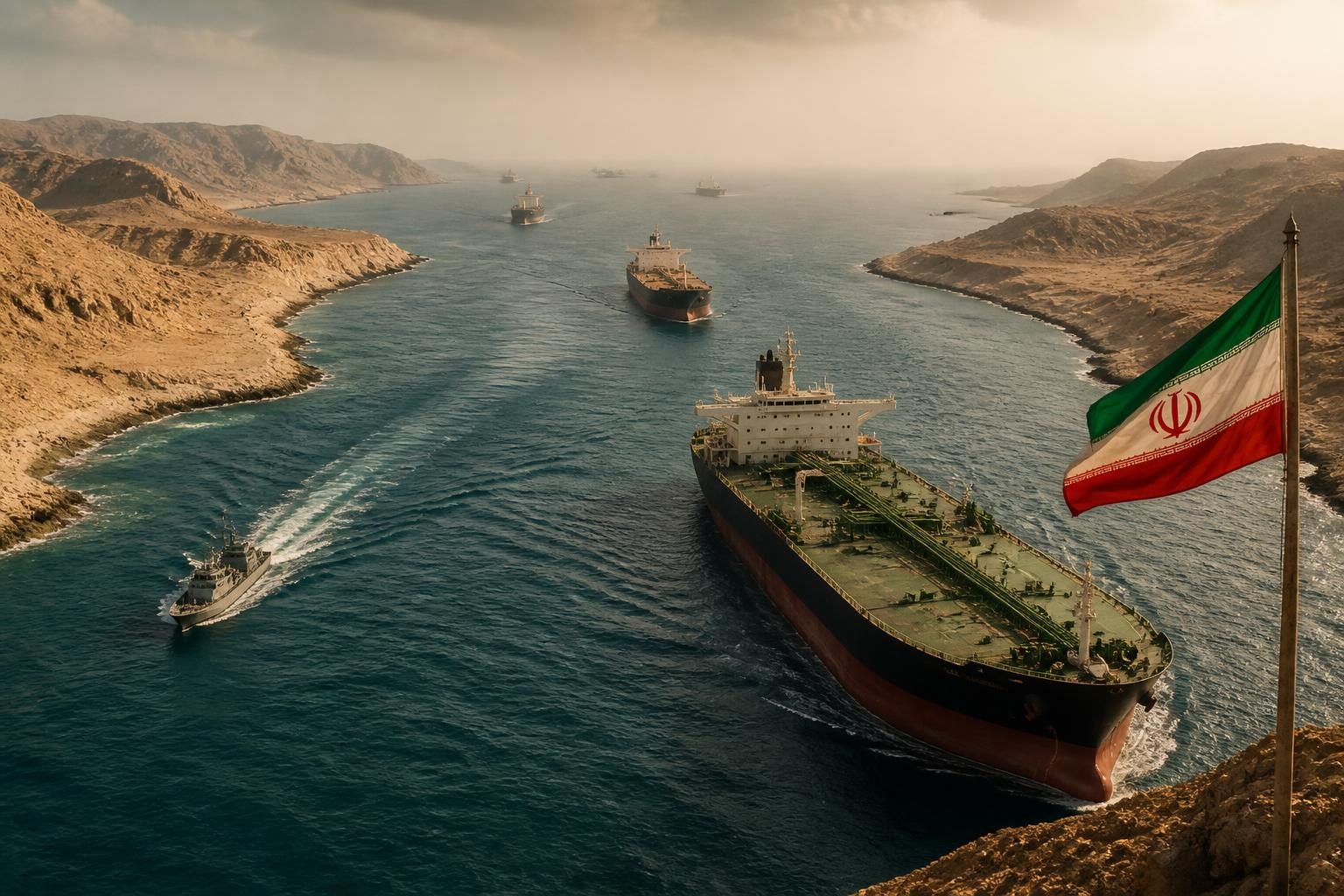
Shipping through the Strait of Hormuz remains sharply disrupted, even as some oil tankers continue to move through the waterway. The latest attention centers on a widening gap between U.S. government claims that millions of barrels of oil are still passing through the strait and estimates from commercial tracking firms that show substantially less traffic.
The issue is drawing renewed interest because the strait is one of the world’s most important energy chokepoints. Before the current conflict, roughly one-quarter of global seaborne oil trade passed through it, along with major volumes of liquefied natural gas. A sustained disruption can affect crude prices, fuel costs, refinery operations, shipping insurance and the availability of energy products far beyond the Persian Gulf.
What is happening now
As of Tuesday, August 25, 2026, the waterway is not operating like a normal, open commercial shipping route. Some vessels have continued to transit, but traffic is limited, security risks remain high and there is no broadly accepted guarantee of safe passage.
The International Maritime Organization, the United Nations agency responsible for maritime safety, said its latest incident list included 68 confirmed incidents in the Middle East as of August 21. The list included damaged vessels in the Strait of Hormuz on August 15 and August 17, with one reported seafarer fatality in each incident. The IMO has also said that around 20,000 seafarers in the region are affected by the crisis, including people on vessels unable to leave the Gulf.
Commercial traffic data remains difficult to interpret. The International Energy Agency says ships in the region have been affected by GPS jamming, spoofed automatic identification signals and vessels turning off tracking systems. Those practices can make a ship’s location or cargo harder to verify, but they do not by themselves prove that a larger volume of oil is moving than public trackers can see.
Why oil-flow estimates do not match
The Trump administration has said that large amounts of oil are continuing to leave the Gulf through a U.S.-supported maritime corridor. Energy Secretary Chris Wright said the military had helped move more than 15 million barrels of crude and petroleum products on one recent day and described the seven-day average as more than 8 million barrels a day, according to reporting by The Wall Street Journal.
Those figures have not been fully corroborated by the industry firms that monitor tanker movements, port activity and oil shipments. A recent report by The Wall Street Journal said tracking companies were observing lower volumes. Argus reported that TankerTrackers.com estimated nearly 6 million barrels a day of crude exports from the Middle East over the most recent seven-day period it reviewed—roughly one-third of the prewar average cited in that report.
Several factors may explain at least part of the discrepancy:
- Different definitions: Officials and commercial firms may be counting different categories, such as crude oil alone versus crude plus refined products and other petroleum cargoes.
- Timing differences: One-day movements, weekly averages, cargo loadings and completed deliveries can produce different results.
- Tracking gaps: AIS signals can be switched off or manipulated, particularly in a conflict zone.
- Ship-to-ship transfers: Oil may be moved between vessels, temporarily stored or transferred outside the most visible shipping lanes.
- Protected or unusual routes: Some Gulf exporters are using shuttle operations and routes close to Oman, which may complicate efforts to classify a shipment as a conventional Hormuz transit.
The key point is that the overall direction is clearer than the exact number: oil is still moving, but the flow is well below normal and the available data is incomplete.
Why the strait matters
The Strait of Hormuz is a narrow waterway between Iran and Oman that connects the Persian Gulf with the Gulf of Oman and the wider Indian Ocean. It is the main maritime outlet for oil and gas produced by several Gulf states, including Saudi Arabia, the United Arab Emirates, Iraq, Kuwait, Qatar and Iran.
The IEA has described the disruption as the largest supply interruption in the history of the global oil market. In its August oil-market report, the agency said regional exports, including shipments using routes that bypass the strait, fell to about 15 million barrels a day after the waterway was effectively closed again in early July. The agency also reported that Gulf oil production remained well below prewar levels and that global inventories had fallen sharply through July.
Not every barrel produced in the Gulf must pass through Hormuz. Saudi Arabia and the United Arab Emirates have alternative pipelines and export terminals that can move some oil to the Red Sea or the Gulf of Oman. Those routes, however, cannot immediately replace the full capacity of the strait, and countries such as Kuwait, Qatar, Bahrain, Iraq and Iran remain heavily dependent on it for exports.
What the disruption means for Americans
The United States is less dependent on Gulf oil imports than it was in previous decades, but Americans are still exposed to global energy markets. Crude oil is traded internationally, so a disruption that removes supply from the world market can raise prices even when U.S. production remains steady.
The effects may appear first in wholesale markets and in sectors that use large amounts of fuel. Refiners outside the region may face higher crude costs or difficulty obtaining particular grades of oil. Airlines, trucking companies, shipping firms and manufacturers may see higher expenses. Consumers could eventually encounter higher prices for gasoline, diesel, jet fuel and goods transported by sea.
The impact is not automatic or uniform. Prices also depend on demand, inventories, production elsewhere, refinery capacity, government stockpiles and expectations about how long the disruption will last. A short-lived interruption may cause a sharp market reaction that later fades. A prolonged reduction in exports can create more persistent pressure, especially if inventories continue to decline.
What is known about maritime safety
The IMO has repeatedly warned that commercial decisions to enter or leave the strait must account for serious risks to crews and ships. In June, the organization said there were no reliable security assurances for ordinary commercial passage. Its voluntary evacuation framework, created to help vessels stranded in the Gulf, has been paused.
The IMO said 136 vessels and approximately 2,900 seafarers were evacuated under the framework during operations in late June. The agency’s current guidance emphasizes that the safety of seafarers must take priority over commercial schedules and cargo movements.
The organization has also condemned attacks on civilian commercial ships and reaffirmed the principle of freedom of navigation under international law. Those legal principles do not mean that a route is practically safe. In a war zone, a waterway may remain legally important while being too dangerous for many shipowners and crews to use.
What happens next
The immediate questions are whether the United States and Iran can reach an arrangement that permits predictable commercial transit, whether regional governments can support a workable security framework and whether shipowners believe those guarantees are credible.
Diplomatic efforts involving Iran and Oman have focused on managing future traffic through the waterway. The United States has opposed Iranian demands that could amount to a new tolling or administrative system for passage. Meanwhile, Iran has threatened restrictions against vessels it says violated its transit rules, adding another layer of uncertainty for shipping companies.
Markets and governments will also watch several practical indicators:
- Daily tanker movements: A sustained increase in verified outbound traffic would suggest that the route is becoming more usable.
- Incident reports: New attacks, damage or detentions could quickly reverse any improvement.
- Oil inventories: Continued stock declines would increase pressure on refiners and fuel markets.
- Alternative export routes: Pipeline and port capacity outside Hormuz may soften the shock but cannot fully replace the strait.
- Official and independent data: Greater agreement between government claims, port records and vessel-tracking firms would make the situation easier to assess.
For now, the most defensible description is neither that the Strait of Hormuz is fully closed nor that it is functioning normally. It is a high-risk, partially operating waterway with sharply reduced and difficult-to-measure traffic. That uncertainty—along with the strait’s central role in global energy trade—is why the topic remains a major international news story.