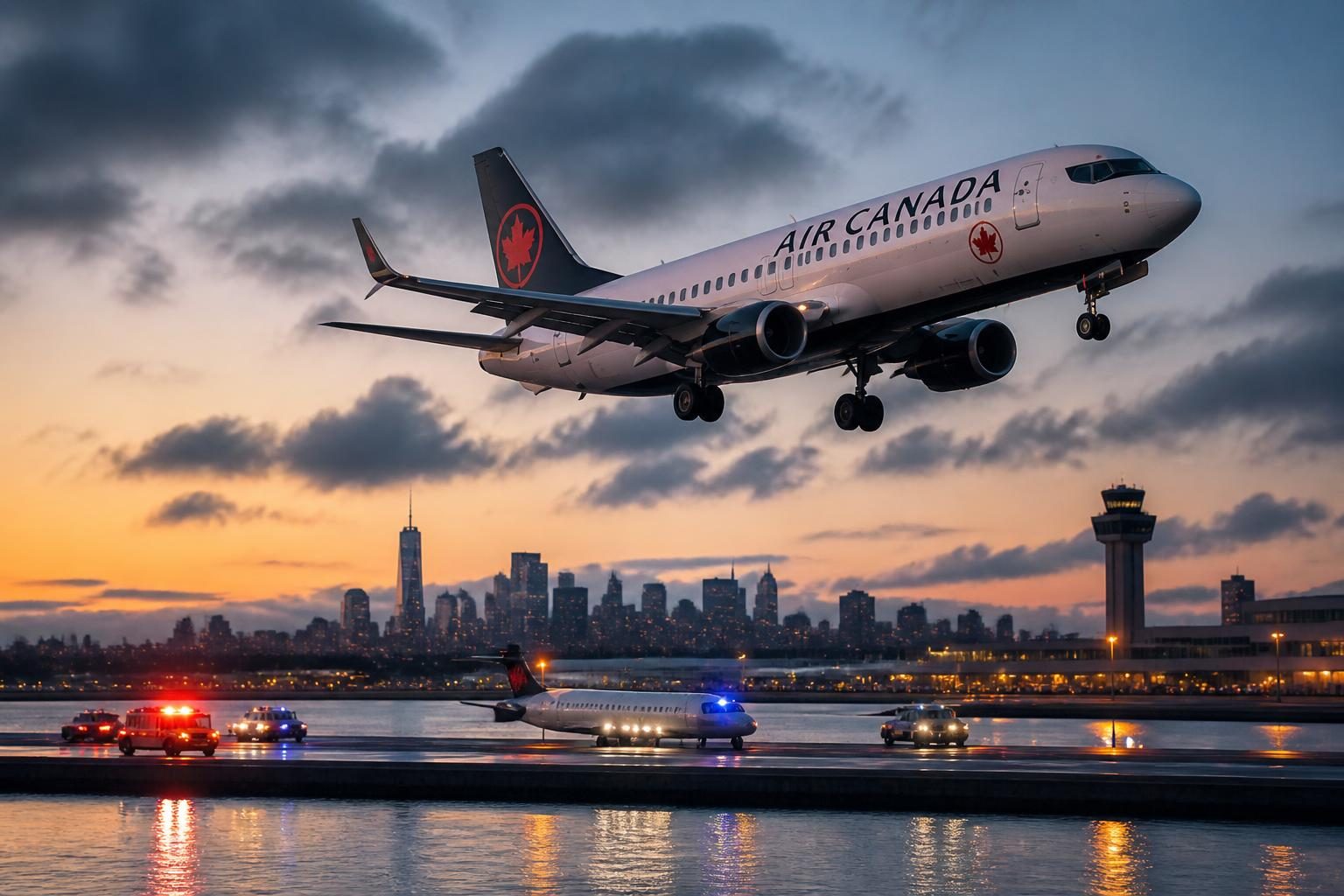
Air Canada is trending because the Federal Aviation Administration is reportedly seeking to fire two air traffic controllers who left New York’s LaGuardia Airport tower before the end of their shifts on the night a fatal collision involving an Air Canada Express jet occurred.
The reported personnel action is the latest development in an investigation into the March 22, 2026, collision between Air Canada Express Flight 8646 and an airport firefighting vehicle. The crash killed the flight’s captain and first officer and injured other people aboard the aircraft and fire truck.
The FAA action has been reported by multiple news organizations citing people familiar with the matter. The agency has not publicly identified the controllers, and the disciplinary process is not the same as a final finding that their actions caused the collision. The National Transportation Safety Board, which is leading the accident investigation, has said its findings remain preliminary.
What happened at LaGuardia
Air Canada Express Flight 8646 was operated by Jazz Aviation on behalf of Air Canada. The CRJ-900 regional jet was flying from Montréal–Trudeau International Airport to LaGuardia on the night of March 22.
According to the NTSB, the aircraft collided with an Oshkosh Striker 1500 aircraft rescue and firefighting vehicle while landing on Runway 4 at approximately 11:37 p.m. Eastern time. The FAA described the event as occurring around 11:45 p.m. in its initial statement; the NTSB’s preliminary accident record gives the more specific time of 11:37 p.m.
The collision substantially damaged the aircraft. The two pilots were fatally injured. The NTSB said 39 people were transported to local hospitals and that six serious injuries were reported among passengers, flight attendants and the fire-truck crew.
The firefighting vehicle had been responding to another airport emergency. Publicly released accounts and preliminary investigative information indicate that an air traffic controller cleared the vehicle to cross the runway shortly before the Air Canada flight landed, then issued repeated instructions for the vehicle to stop.
Why the controllers’ departure is drawing attention
Reports published August 27 and August 28 say two controllers left the tower approximately an hour before their scheduled shifts ended but remained recorded as working. The alleged practice has been described in some reports as an “early shove,” an informal term for leaving before the end of a shift while coverage continues through other personnel.
At the time of the collision, two controllers were working in the tower, according to preliminary accounts: one handling local air traffic and runway operations and another serving as the controller-in-charge. The question now being examined is whether the earlier departures left the tower without staffing that was required or expected for the airport’s operations at that time.
The FAA is reportedly pursuing termination through the federal employee disciplinary process. That means the controllers may have an opportunity to respond or challenge the proposed action before any final employment decision is made.
The reports do not establish that the two controllers who allegedly left early issued the clearance to the fire truck or directly participated in the sequence that led to the collision. Nor do they establish that additional staffing would have prevented the crash. Those are separate questions for investigators.
What investigators have confirmed so far
The NTSB’s preliminary information describes a tightly compressed sequence of events. The fire truck was cleared to cross the runway shortly before the Air Canada aircraft touched down. A controller then transmitted instructions for the vehicle to stop, but the collision occurred before the vehicle could clear the aircraft’s path.
Investigators have also examined runway warning equipment, controller workload, communications and the movement of airport vehicles. A preliminary report is not a final determination of probable cause. Investigators can revise facts, interpretations or conclusions as additional evidence is analyzed.
The NTSB has not announced a final cause for the collision. In aviation investigations, the final report typically considers multiple contributing factors rather than assigning responsibility to a single person or organization.
The investigation is also distinct from the FAA’s employment inquiry. The FAA regulates and operates the nation’s air traffic control system, while the NTSB independently investigates major transportation accidents and determines probable cause.
What remains uncertain
There is no final public finding that the controllers’ alleged early departure caused the collision. The available reporting establishes that the FAA is taking or considering disciplinary steps, but it does not resolve how staffing levels, workload, procedures, equipment or communications interacted that night.
It is also unclear from the publicly available information whether the FAA’s review will result in additional personnel actions. Reports have said the agency is examining broader time-card irregularities at air traffic control facilities, but the scope and results of that review have not been fully disclosed.
The identity of the two controllers has not been publicly released in the official FAA and NTSB materials reviewed for this article. They should not be presumed responsible for the accident merely because the FAA is pursuing disciplinary action.
The exact significance of the airport’s staffing configuration is another unresolved issue. A tower may legally or operationally combine positions under some circumstances, but specific staffing rules, local procedures and the conditions in effect at the time must be evaluated using official records, recordings and witness accounts.
Why this matters beyond Air Canada
The incident has renewed attention on the demands placed on air traffic controllers, especially during overnight or lower-traffic periods when staffing can be thinner but emergencies still develop quickly.
Controllers coordinate aircraft in the air, aircraft on runways and taxiways, and ground vehicles such as fire trucks and maintenance equipment. These movements are governed by clearances intended to keep aircraft and vehicles separated. A runway crossing can become hazardous when an aircraft is approaching, when radio communications are misunderstood or when a controller is managing several tasks at once.
The case also highlights the difference between an airline’s responsibility and an airport-control issue. Air Canada marketed the flight, but Jazz Aviation operated the aircraft. The collision occurred on the airport surface and involved air traffic control and airport emergency-response operations. The NTSB’s investigation will examine the entire sequence rather than focusing only on the airline.
For travelers, the event does not by itself indicate that all Air Canada flights or all regional aircraft are unsafe. It is a specific accident under investigation. Safety recommendations, if issued, would be based on evidence from this event and any related safety analysis.
What happens next
The NTSB’s investigation remains ongoing. Investigators are expected to continue reviewing flight data, cockpit and tower communications, airport surveillance information, vehicle records, staffing and time-clock data, runway-warning systems and witness interviews.
The FAA’s personnel process will proceed separately. A proposed firing is not necessarily a final firing, and the agency may not disclose every step because federal employee disciplinary proceedings can involve privacy restrictions.
A final NTSB report could take substantially longer than a preliminary report. It may identify probable cause, contributing factors and safety recommendations for the FAA, airports, airlines or other organizations. Until then, statements about blame should be treated cautiously.
Bottom line
Air Canada is trending because new reports connect a proposed FAA disciplinary action to the deadly March 2026 LaGuardia runway collision involving an Air Canada Express jet and a fire truck.
What is confirmed is that the collision killed both pilots, injured others and remains under investigation. What is newly reported is that two controllers allegedly left the tower early and that the FAA is seeking to fire them. What is not yet confirmed is whether those departures contributed to the crash or how responsibility will ultimately be divided among staffing, procedures, communications, equipment and operational decisions.