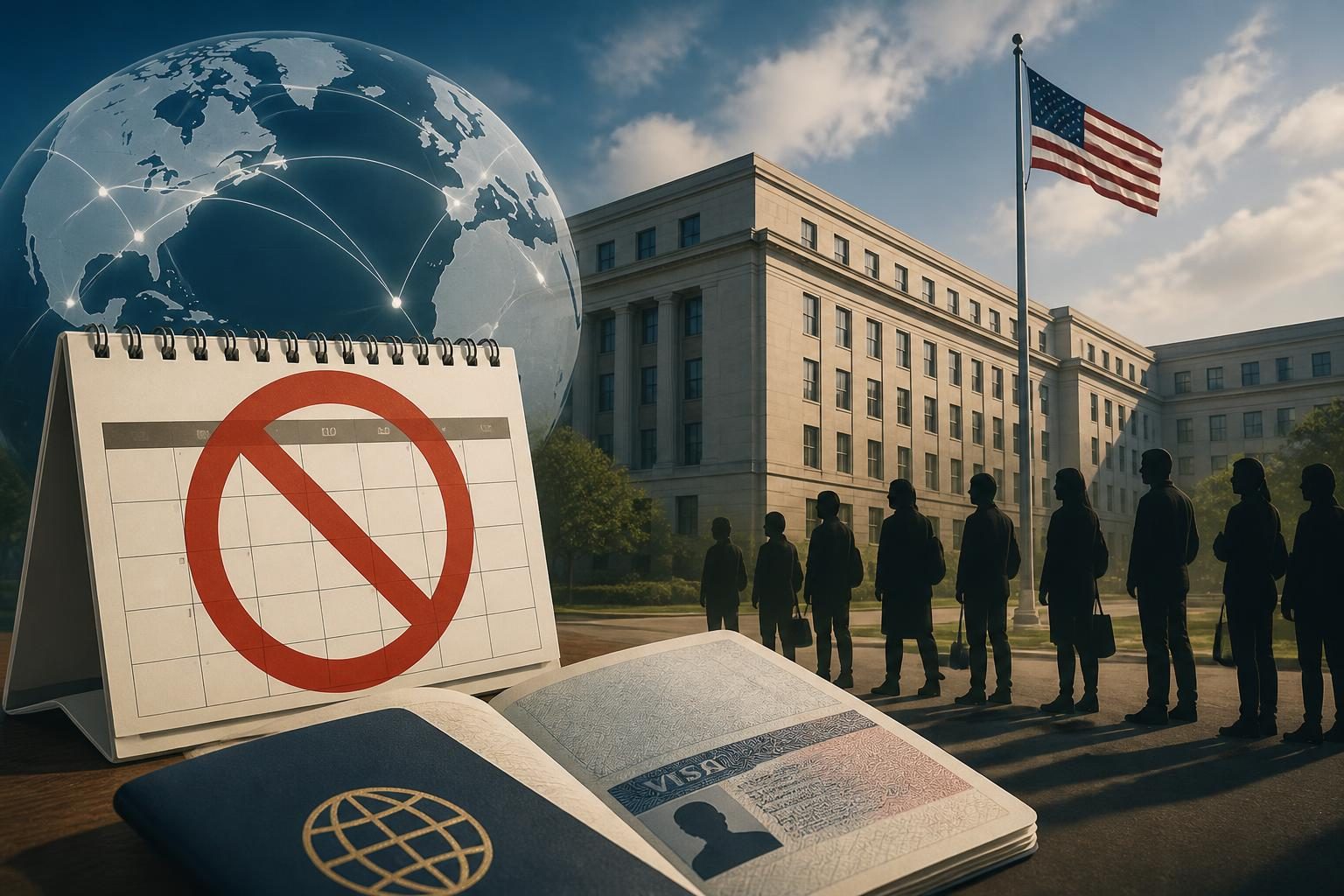
The State Department has temporarily paused or adjusted immigrant visa appointments at U.S. embassies and consulates worldwide while consular officers receive training on how to evaluate whether applicants could become dependent on public benefits, according to a State Department statement reported by The Washington Post.
The development is drawing attention because it affects the process for people seeking permanent residence in the United States, including some family members, employment-based applicants and other immigrant visa applicants waiting for interviews abroad. The pause comes days after a federal judge struck down a separate Trump administration policy that had suspended immigrant visa processing for nationals of 75 countries.
The State Department has not publicly announced a firm date for when the worldwide appointment adjustments will end. Reporting from The Washington Post said the appointments had been paused beginning Monday, August 24, 2026, with a former State Department official describing an initial pause through the end of August. The department itself said only that appointments were being “adjusted” as part of a global training initiative.
What has been confirmed
The confirmed action concerns immigrant visa appointments—the interviews generally required by people applying for permanent residence from outside the United States. It is not the same as a blanket suspension of every U.S. visa service worldwide.
The State Department told The Washington Post that consular officials are being trained to screen applicants under the “public charge” framework. In immigration law, a public charge is generally a person officials determine is likely to become primarily dependent on the government for support. The department said the training is intended to help officers evaluate visa applicants “comprehensively and consistently.”
The department has not released a complete public schedule showing which individual embassies have stopped accepting new immigrant visa appointments, how many appointments are affected, or when normal scheduling will resume. Applicants should therefore rely on notices from the embassy handling their case and updates from the National Visa Center rather than assuming that every appointment has been canceled.
The State Department’s broader visa notices also show that operations can vary by location. For example, the department separately paused all visa services at U.S. embassies in Juba, South Sudan; Kinshasa, Democratic Republic of the Congo; and Kampala, Uganda, because of an Ebola outbreak. That earlier, location-specific action covered both immigrant and nonimmigrant visas and is distinct from the worldwide immigrant-appointment adjustment now being reported.
Why the issue is trending now
The appointment pause follows a major legal setback for the administration’s immigration policy. On August 21, 2026, U.S. District Judge Jeannette Vargas vacated a policy that had suspended processing of immigrant visas for nationals of 75 countries. The policy was justified by the administration as a way to prevent people likely to rely on public assistance from entering the United States.
According to The Associated Press, Judge Vargas ruled that the policy was contrary to law and exceeded the authority granted to the secretary of state. She also said immigration law gives consular officers the responsibility and discretion to decide whether a particular applicant is eligible for a visa based on the facts of that person’s case.
The timing has led to questions about whether the new training initiative is connected to the court ruling. The Washington Post reported that training materials were being rolled out after the judge’s decision. However, the State Department has described the appointment changes as part of a global training initiative and has not publicly said that the pause was ordered because of the ruling. Any direct causal connection remains unconfirmed.
The development is also part of a broader effort by the Trump administration to tighten legal immigration and visa screening. In 2026, the State Department has issued or announced measures involving public-benefits screening, visa processing locations, diversity visa issuance and other categories. The administration says these steps are intended to protect national security, public safety and public resources. Critics and immigration advocates have argued that broad restrictions can delay family reunification and make lawful immigration less predictable.
What “immigrant visa” means—and what it does not mean
An immigrant visa is issued to a person who plans to move permanently to the United States and become a lawful permanent resident. Many applicants are sponsored by a U.S. citizen or lawful permanent resident relative. Others qualify through employment, family preference categories, special immigrant classifications or the diversity visa program.
A nonimmigrant visa, by contrast, is generally issued for a temporary purpose. Tourist and business visas, student visas and many temporary work visas fall into that category.
The distinction matters because the State Department’s January 2026 public-charge-related notice said affected immigrant visa applicants could still submit applications and attend interviews, even though visa issuances were paused for nationals of listed countries. That notice expressly said the pause did not apply to tourist visas. The current worldwide appointment adjustment is described in reporting as an immigrant-visa action, not a general halt to tourist, student or business visa appointments.
Applicants should not assume that a pause affecting immigrant visa interviews automatically cancels a valid visa already issued. In a separate State Department notice covering visa operations at three African posts, the department said the operational pause did not affect currently valid visas. The department’s public-charge notice likewise said no immigrant visas had been revoked as part of that guidance.
What applicants should do
If you already have an appointment
Check the email address and phone number associated with your case, as well as the website of the embassy or consulate listed in your appointment notice. Do not skip a scheduled interview based solely on social-media posts or search trends.
The State Department’s standing guidance says existing immigrant visa appointments will generally not be rescheduled or canceled when an applicant is affected by a change in processing location. That guidance is not a specific guarantee about the current worldwide adjustment, so applicants should follow any direct notice from their assigned post.
If an appointment is canceled or moved, keep copies of the notice and follow the instructions about rescheduling. Applicants should also check whether medical examinations, police certificates and other documents will remain valid through the new interview date.
If you are waiting for an appointment
Continue completing requested steps unless the National Visa Center or consular post tells you otherwise. That may include submitting civil documents, financial forms, police certificates, translations and medical-examination information.
Applicants whose cases are being handled at a post that no longer conducts routine visa operations may need to use a designated processing post. Since November 1, 2025, the State Department has generally directed immigrant visa applicants to interview in the consular district where they live, or in their country of nationality if requested, subject to limited exceptions.
Requests to transfer a case after the National Visa Center has scheduled an appointment should generally be directed to the National Visa Center through its public inquiry process, rather than sent directly to a consular section. The State Department says rare exceptions may be available for humanitarian, medical-emergency or foreign-policy reasons.
If you are worried about deadlines
Do not abandon a case simply because an appointment is delayed. Visa cases can involve separate deadlines, including petition validity, document expiration, medical-examination validity and annual visa-number limits. Applicants with imminent deadlines should consult an immigration attorney or an accredited legal-services provider and ask the relevant government office for case-specific instructions.
People applying for adjustment of status from inside the United States generally follow a different process through U.S. Citizenship and Immigration Services. A pause in overseas immigrant visa appointments does not automatically mean that every adjustment-of-status application inside the United States is paused.
What happens next
The immediate question is when the State Department will finish the training and resume ordinary appointment scheduling. The department has not provided a public end date. Embassies and consulates may also resume at different times depending on staffing, local capacity and the type of case being handled.
The legal status of the administration’s public-charge-related policies is another issue to watch. The federal ruling on the 75-country policy may be appealed or otherwise litigated, and the administration could revise its screening instructions. Those developments could affect how consular officers evaluate individual cases, but they do not establish that every immigrant visa applicant will be denied or delayed for the same reason.
For now, the most accurate description is limited but significant: the State Department is adjusting immigrant visa appointments worldwide to train consular personnel on public-benefits screening, while the agency’s broader visa system continues to operate under a mix of country-specific, category-specific and location-specific rules.
Applicants should use the State Department’s visa website, the website of the embassy or consulate handling the case, and official messages from the National Visa Center for updates. Because policies and appointment availability can change quickly, information posted by private visa agents or shared online should be checked against those official sources.