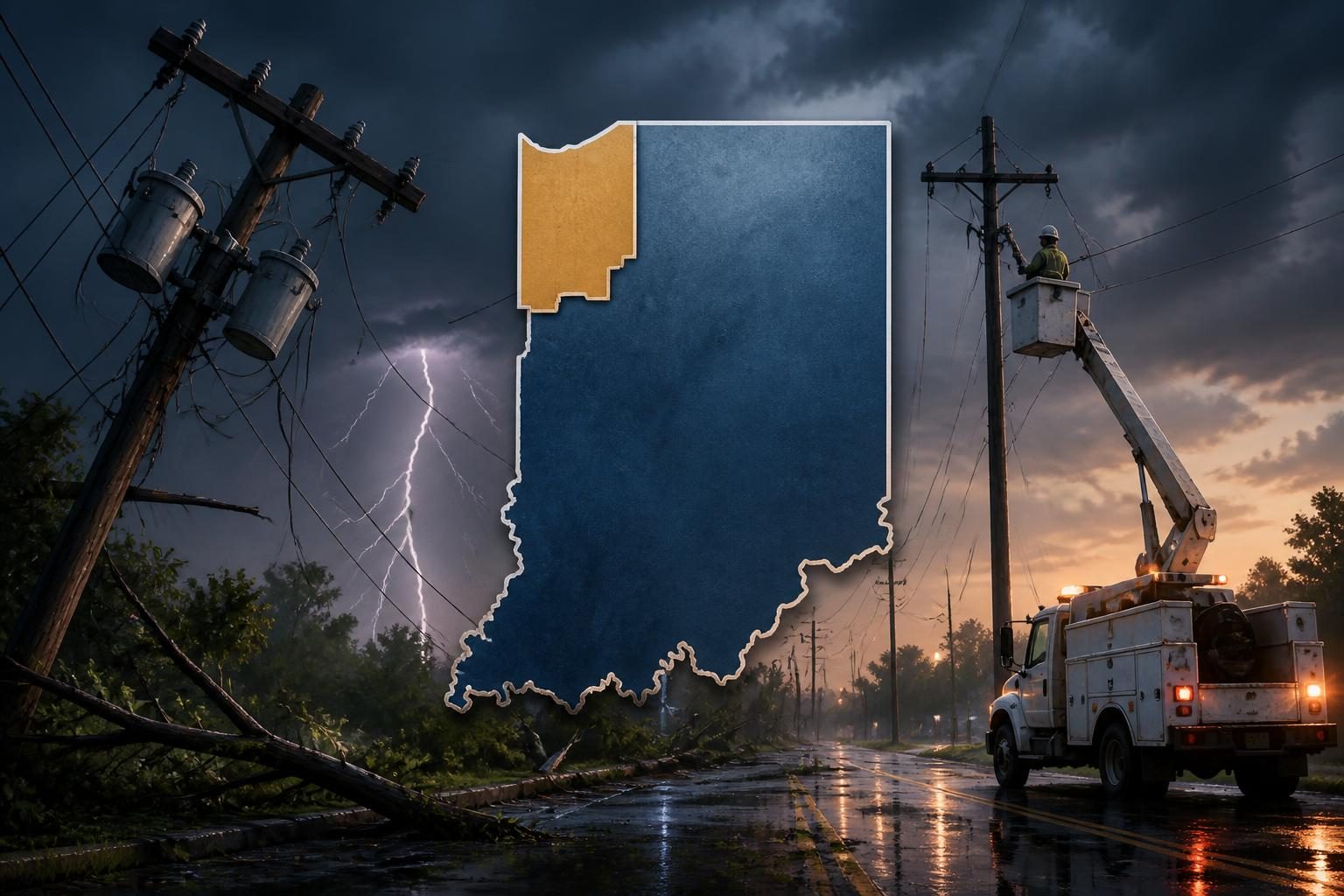
Indiana is trending because a prolonged power outage in Northwest Indiana has left thousands of residents without electricity more than a week after severe storms damaged the region. Gov. Mike Braun on Monday, August 24, called for an investigation by the Indiana Utility Regulatory Commission into NIPSCO’s preparedness, infrastructure maintenance and storm response.
The outage is also drawing attention because the August 11 storms caused unusually extensive damage across NIPSCO’s service territory. The utility has said crews have had to rebuild substantial portions of the electric system, including damaged poles and other equipment.
What is happening in Indiana
Nearly 10,000 NIPSCO customers remained without power as of Monday morning, according to WSBT, citing updated restoration information. NIPSCO said Sunday that it hoped to restore all customers by the end of Tuesday, August 25, although restoration estimates can change as crews identify additional damage.
The outages are concentrated in Northwest Indiana, including communities in and around Lake, Porter and LaPorte counties. The affected area includes Gary, Highland, Munster, Valparaiso, Chesterton, Merrillville and other communities served by NIPSCO.
NIPSCO’s public outage information showed that the August 11 event affected hundreds of thousands of customers over the course of the restoration effort. In an August 19 update, the company reported 87,745 customers without power at that time, after restoring service to more than 282,000 customers. The company said the storm had generated approximately 370,000 outages cumulatively since August 11.
Those figures represent outage events and customers affected over time, not necessarily the number of individual households that were without power simultaneously. That distinction matters because a single customer may experience more than one interruption during a large restoration operation.
Why Gov. Braun is seeking an investigation
Braun asked the Indiana Utility Regulatory Commission, or IURC, to examine whether NIPSCO was adequately prepared for the storms and whether it maintained vegetation near electric infrastructure. Vegetation management generally refers to trimming or removing trees and branches that can damage power lines during severe weather.
The governor also wants the commission to review whether state funding intended for infrastructure improvements was used as promised. His request is an allegation and a call for regulatory review, not a finding that NIPSCO violated state requirements.
In a statement reported by WSBT, Braun criticized NIPSCO’s performance and said customers expect the utility to maintain its system, prepare for severe weather and restore service quickly. The IURC investigation would be the process for testing those concerns against the utility’s records, engineering decisions and storm-response evidence.
What NIPSCO says about the delays
NIPSCO has attributed the extended restoration timeline to the scale of the damage. The company said the August 11 storms significantly damaged power poles and required crews to rebuild large portions of the system rather than simply reconnect individual lines.
The Associated Press reported that the storms produced winds of up to 99 mph in parts of Northwest Indiana and that roughly 300 distribution poles and 44 transmission poles needed repair or replacement in Gary. Distribution poles typically carry electricity to neighborhoods and businesses, while transmission poles support higher-voltage lines that move electricity across larger areas.
NIPSCO has brought in outside crews and continued working in an emergency-response posture. The utility has cautioned that community-level estimates are not exact appointment times for individual homes. A neighborhood may regain service while specific homes remain disconnected because of damage to a service line, meter equipment or privately owned electrical infrastructure.
Why restoration can take more than a week
Large storms can create several layers of damage. Crews may first need to clear roads and make dangerous areas safe before repairing the electric system. They then typically assess damage, isolate energized equipment, replace broken poles and wires, restore major transmission and distribution lines, and reconnect individual customers.
Some homes also require repairs before electricity can safely be restored. NIPSCO has told some Northwest Indiana residents that damage to customer-owned equipment or service connections must be corrected before crews can complete restoration. That can include damaged weatherheads, electrical panels or lines running from a utility pole to a building.
Downed lines and unstable poles create additional safety risks. A line that appears inactive can still be energized, and residents are advised not to touch lines, trees, fences, vehicles or standing water that may be in contact with electrical equipment.
What has been confirmed—and what remains uncertain
Confirmed
- Severe storms struck Northwest Indiana on August 11, 2026, causing widespread damage and extended power outages.
- NIPSCO reported hundreds of thousands of customer outage events during the restoration effort.
- Thousands of customers remained without power on Monday, August 24.
- Gov. Braun requested an IURC investigation into NIPSCO’s preparedness, vegetation management and use of infrastructure funding.
- NIPSCO said it expected restoration to be substantially complete by Tuesday, August 25, subject to damage and safety conditions.
Not yet established
- Whether NIPSCO’s preparation or maintenance practices contributed to the length of the outages.
- Whether any infrastructure funding was misused or improperly allocated.
- Whether the IURC will open a formal investigation, what records it will review or whether it will impose penalties or require corrective action.
- Whether every remaining customer will be restored by the utility’s current target.
The governor’s request should therefore be understood as the beginning of a possible regulatory review, not as a final judgment about the utility’s performance.
What happens next
The immediate priority is restoring service safely. NIPSCO’s latest target is to complete substantially all restoration by the end of Tuesday, August 25. Customers should rely on the utility’s outage map and direct alerts for location-specific information because restoration times can change as crews inspect damaged equipment.
The IURC has an online system for docketed cases and filings. If the commission accepts Braun’s request or opens a related proceeding, the case could eventually include filings from state officials, NIPSCO, consumer advocates and other interested parties. Any formal conclusions would come later, after the commission reviews evidence.
Residents who remain without power should report the outage through NIPSCO’s official channels even if they previously reported it. Customers can use the utility’s website, text “OUT” to 444111, or call 1-800-464-7726. Anyone who sees a downed power line should stay away, call 911 and then contact NIPSCO.
Practical help for affected residents
- Keep away from downed lines, damaged poles and areas where trees or wires may be unstable.
- Use generators outdoors and well away from doors, windows and vents to prevent carbon monoxide poisoning.
- Check on neighbors who may rely on electrically powered medical equipment, while calling 911 for medical emergencies.
- Use Indiana’s shelter and cooling-center information, along with Indiana 211, for assistance with temporary needs.
- Photograph storm damage and keep receipts for emergency expenses if documentation is needed for insurance or assistance programs.
- Do not assume that a restoration estimate guarantees power at a particular hour or that a neighborhood estimate applies to every address.
Indiana is trending because the outage has become both a public-safety emergency for residents and a policy dispute over utility reliability. The central unanswered question is not whether the August 11 storms caused major damage—they did—but whether the length and management of the restoration reflected unavoidable storm conditions, preventable infrastructure weaknesses, or some combination of the two. The IURC review, if opened, would be the mechanism for determining that.