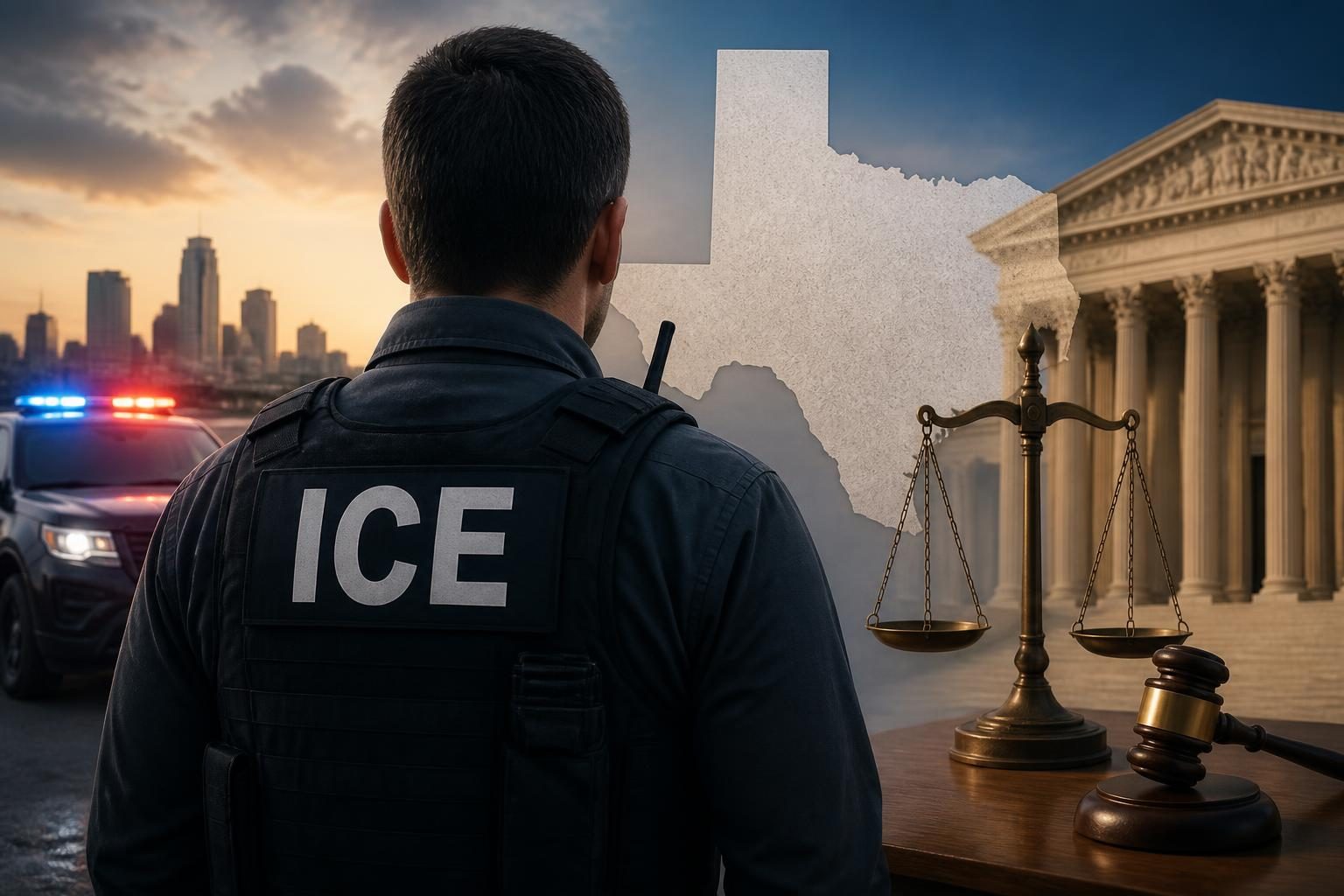
Christian Castro is trending after the ICE agent charged in a January shooting in Minneapolis was released from a Texas jail on Thursday, August 27, 2026. The release followed a federal judge’s decision not to order Texas officials to send Castro to Minnesota or keep him jailed while the states’ extradition dispute continued.
Castro faces four counts of second-degree assault and one count of falsely reporting a crime in Minnesota. Prosecutors allege that he fired through a closed door during an encounter in north Minneapolis on January 14, striking Julio Cesar Sosa-Celis, a Venezuelan man, in the leg. Castro has not been convicted, and the charges remain allegations.
The case has drawn attention because it combines a criminal prosecution involving a federal immigration officer with an unusual dispute between Minnesota and Texas over interstate extradition. It also comes amid heightened national scrutiny of federal immigration operations in Minneapolis.
What happened Thursday
Castro was released from Cameron County Jail in Brownsville, Texas, early Thursday, according to the Cameron County sheriff and reporting by The Associated Press. He had been held there since his arrest by Texas Rangers on May 29 under a Minnesota warrant.
His release followed a ruling by U.S. District Judge Fernando Rodriguez Jr. of the Southern District of Texas. The judge rejected Minnesota’s request to compel Texas Gov. Greg Abbott to facilitate Castro’s extradition and declined to keep Castro in custody beyond the period allowed under Texas law while the matter was litigated.
Under Texas law, a person held on an out-of-state extradition matter generally cannot remain jailed indefinitely without further legal action. Castro’s 90-day detention period ended Thursday, making his release possible after the court declined to impose additional restrictions.
Release does not mean the Minnesota case has been dismissed, nor does it mean a court has ruled that Castro is innocent. It means only that he is no longer being held in the Texas jail on the Minnesota extradition request.
The charges against Christian Castro
Minnesota prosecutors charged Castro on May 18 in connection with the January 14 shooting. The criminal complaint says Castro fired a weapon through the door of a Minneapolis home and hit Sosa-Celis in the leg.
According to the charging documents, investigators also concluded that Castro gave accounts of the incident that were inconsistent with other evidence. That led to the additional charge of falsely reporting a crime.
The complaint describes a probable-cause finding, which is the legal threshold used to justify criminal charges and an arrest. It is not a finding of guilt. The allegations will have to be tested in court if the case proceeds.
Publicly available court documents identify Castro as an Immigration and Customs Enforcement officer. Minnesota officials have argued that his federal employment does not shield him from state criminal charges for conduct allegedly committed in Minnesota.
The alleged shooting occurred during Operation Metro Surge, a federal immigration enforcement effort in Minneapolis that has been the subject of broader political and legal disputes. The operation’s context helps explain why the case has received attention, but it does not establish whether the shooting allegations are true.
Why Minnesota and Texas are fighting
After Minnesota issued a warrant, Texas Rangers arrested Castro in Texas on May 29. Minnesota officials then sought the governor’s approval to complete the extradition process and return Castro to Minnesota to face the charges.
Minnesota Attorney General Keith Ellison and Hennepin County Attorney Mary Moriarty said Texas had a duty to honor the request. On August 18, Ellison sued Abbott in federal court, asking a judge to require Texas to move forward and prevent Castro’s release.
Texas officials took a different position. Abbott’s administration questioned whether Castro legally qualified as a “fugitive from justice,” a term used in extradition proceedings. The Texas position, as described in court filings and reporting by The Texas Tribune, was that Castro may not have fled Minnesota to avoid prosecution because he was apparently reassigned to Texas by ICE.
Minnesota officials called that distinction a distraction, arguing that Castro was in Minnesota when the alleged crime occurred and was later found in Texas. The dispute therefore centered not on whether Minnesota had filed criminal charges, but on whether Texas could delay or refuse the transfer.
What the judge’s ruling means
The ruling resolved the immediate detention issue in Texas but did not determine whether Castro committed the alleged shooting. It also did not amount to a dismissal of the Minnesota charges.
For now, Minnesota still has criminal charges and a warrant, while Castro is outside the state. The practical challenge for prosecutors is getting him before a Minnesota court. The available reporting does not establish where Castro went after his release or whether he has entered a formal agreement to appear in Minnesota.
The ruling also illustrates the limits of using a federal lawsuit to force a governor to act quickly in an interstate extradition dispute. Minnesota sought emergency relief because Castro’s detention deadline was approaching. The judge declined to grant that relief before the deadline passed.
That does not necessarily end every legal avenue. Minnesota could pursue additional litigation or other procedures, but the precise next steps and their timing were not fully established in the materials reviewed for this report.
What is confirmed — and what is not
Confirmed
- Christian Castro was arrested by Texas Rangers on May 29, 2026.
- He was held in Cameron County Jail in Brownsville, Texas.
- Minnesota charged him with four counts of second-degree assault and one count of falsely reporting a crime.
- The charges arise from a January 14 shooting in Minneapolis that injured Julio Cesar Sosa-Celis.
- Minnesota officials sued Texas Gov. Greg Abbott to compel extradition.
- A federal judge rejected Minnesota’s request to keep Castro jailed or force his immediate return.
- Castro was released from the Texas jail on August 27, 2026.
Not established by the release
- Castro has not been found guilty or acquitted in Minnesota.
- The judge’s ruling did not decide whether he fired lawfully or unlawfully.
- The release does not prove that Texas agreed with Castro’s account of the shooting.
- There is no verified public information in the sources reviewed showing where Castro went after leaving jail.
- It is not yet clear whether Minnesota will secure his appearance through another legal process.
What happens next
The next stage will likely involve the unresolved Minnesota criminal case and any further proceedings over Castro’s custody or transfer. Prosecutors may continue seeking a way to bring him before a Minnesota court, while Castro may challenge the charges or contest the state’s authority to prosecute him.
Those developments could include additional court filings, a new extradition request, negotiations between officials, or efforts to establish conditions for a voluntary appearance. None of those outcomes should be treated as certain without new court records or statements from the parties.
The case also remains politically significant because it tests how state officials respond when an employee of a federal immigration agency is accused of conduct that allegedly injured a civilian. But the legal questions are narrower: whether Minnesota can prosecute the alleged conduct, whether Texas must surrender Castro, and how the case can proceed now that he has been released.
For readers following the story, the most important distinction is between release from Texas custody and resolution of the Minnesota charges. As of August 27, 2026, the first has happened; the second has not.
Disclosure: Automation materially assisted with research organization and drafting. Facts were checked against the cited court and news sources before publication.