A deep partial lunar eclipse will be visible across much of the United States late Thursday, Aug. 27, into the early morning of Friday, Aug. 28, 2026. The event is drawing attention because it follows August’s widely discussed total solar eclipse and will be unusually deep for a partial lunar eclipse.
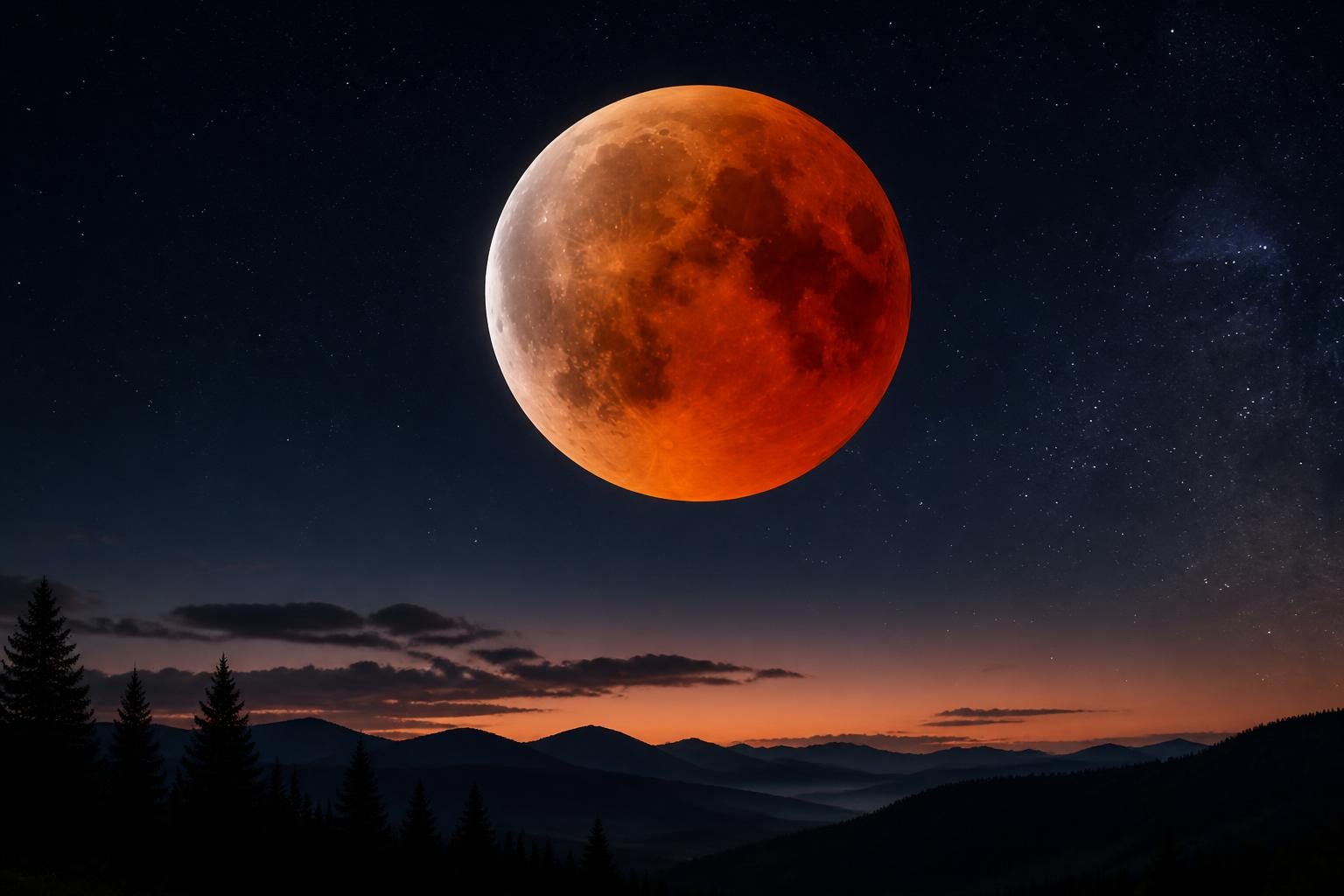
NASA says about 93% of the Moon’s diameter will enter Earth’s dark central shadow, known as the umbra, at maximum eclipse. The Moon will not be fully covered, but the eclipsed edge may appear dark orange, copper or rusty red. The event is safe to view with the unaided eye, unlike a solar eclipse. NASA’s August skywatching guide identifies the eclipse as one of the month’s main observing opportunities.
When the August 2026 lunar eclipse happens
The eclipse’s astronomical date is Aug. 28 in Universal Time, but many people in the United States will begin watching on the evening of Aug. 27. The date varies by time zone because the Moon passes through Earth’s shadow overnight.
NASA’s calculations place the main phases at approximately:
- Penumbral eclipse begins: 1:24 a.m. Universal Time on Aug. 28
- Partial eclipse begins: 2:34 a.m. Universal Time
- Greatest eclipse: 4:13 a.m. Universal Time
- Partial eclipse ends: 5:52 a.m. Universal Time
- Penumbral eclipse ends: 7:02 a.m. Universal Time
Converted to U.S. local time, the partial phase generally begins during the evening of Aug. 27 in the western and central United States and later that night in the East. The exact viewing window depends on location.
For example, Timeanddate’s U.S. visibility table lists the partial phase as beginning at 10:12 p.m. Central Daylight Time and ending at 11:13 p.m. Mountain Daylight Time on its national summary, while city-specific times differ. In Atlanta and Albany, for example, the partial phase is listed from 9:23 p.m. Eastern Daylight Time to 3:01 a.m. Eastern Daylight Time, with maximum eclipse at 12:12 a.m. The site lists Austin and Baton Rouge from 8:23 p.m. to 2:01 a.m. Central Daylight Time, with maximum at 11:12 p.m.
These examples are not a substitute for a local forecast or city-specific eclipse calculator. Moonrise, the Moon’s position in the sky and the local time-zone boundary can affect what an observer sees.
Where people in the United States can see it
NASA lists the Aug. 27–28 partial lunar eclipse as visible from much of North and South America, as well as parts of Europe and Africa. The entire event is most favorably placed for observers in much of the Americas, while locations farther east may see the Moon rise or set during part of the eclipse.
In the United States, the eclipse is expected to be visible from all 50 states, although the amount of the event visible and the Moon’s altitude will vary. Alaska and Hawaii have shorter or less favorable viewing windows in some locations. In the Lower 48, the Moon should be high enough for a substantial portion of the partial phase in many areas, provided skies are clear.
Cloud cover will be the biggest practical uncertainty. Eclipse calculations can predict the timing and geometry years in advance, but they cannot determine whether a particular neighborhood will have clear skies on Aug. 27. Local weather forecasts will become more useful as the date approaches.
What viewers should expect to see
A lunar eclipse occurs when Earth moves between the Sun and the Moon and the Moon passes through Earth’s shadow. During a partial lunar eclipse, only part of the Moon enters the umbra. The rest remains outside the darkest shadow, so the Moon does not disappear completely.
The first stage is the penumbral phase, when the Moon moves through the outer part of Earth’s shadow. This change can be subtle and may be difficult to notice, especially in bright skies or near city lights. The more obvious part begins when the Moon enters the umbra and a curved, darker shadow starts to move across the lunar surface.
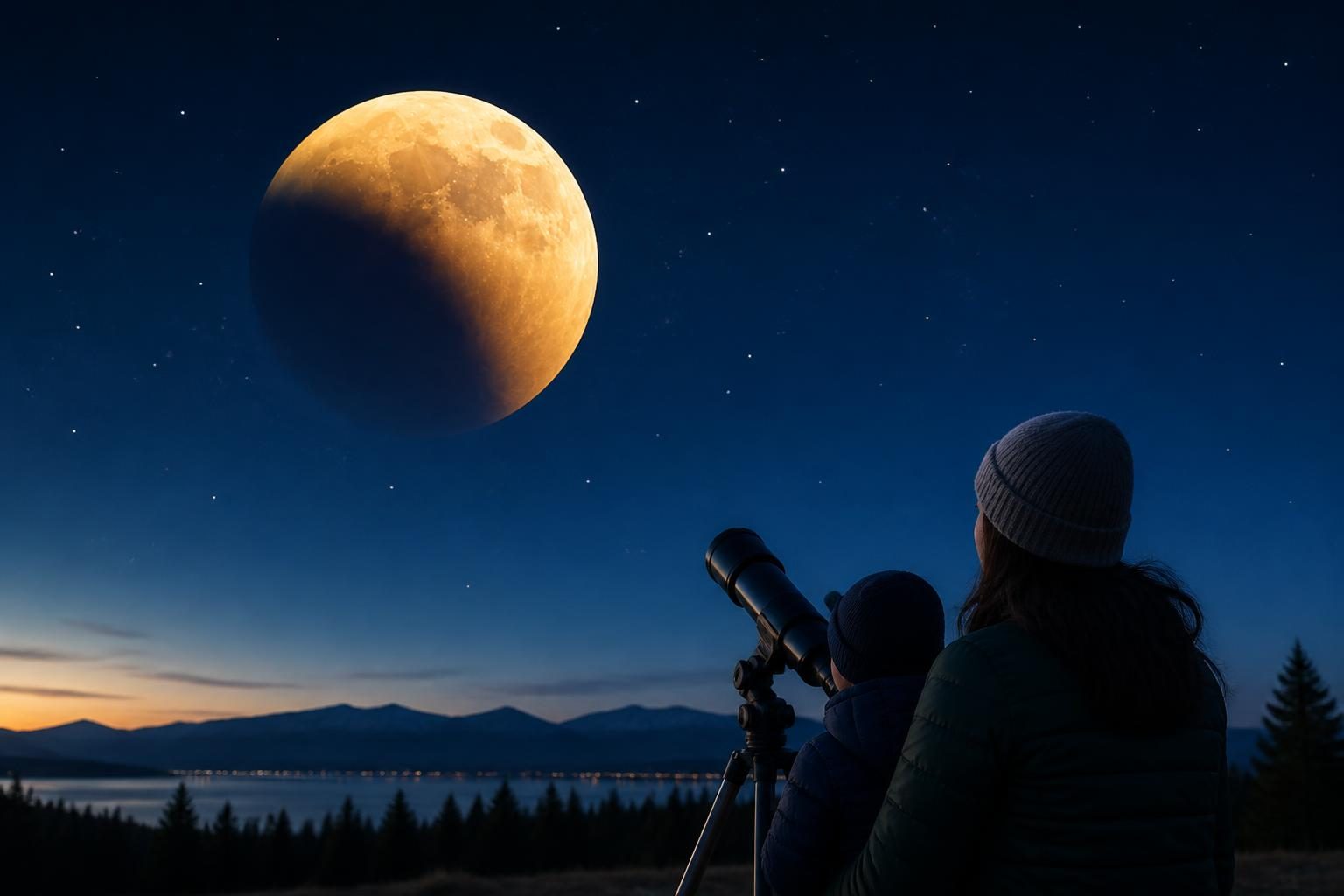
At maximum eclipse, roughly 93% of the Moon’s diameter will be inside the umbra, according to NASA. That makes this a “deep” partial eclipse, but it is important not to confuse that description with a total lunar eclipse. A narrow, bright portion of the Moon is expected to remain outside the darkest shadow.
The covered portion may take on a reddish or coppery color. This happens because Earth’s atmosphere scatters shorter blue wavelengths of sunlight more strongly and allows more of the longer red and orange wavelengths to bend into the shadow. The final color and brightness can vary with atmospheric conditions, including dust and aerosols.
How to watch the eclipse
No special eye protection is needed. A lunar eclipse can be viewed safely directly with the naked eye throughout the event. Binoculars or a small telescope can make the edge of Earth’s shadow easier to follow, but they are optional.
Simple viewing tips
- Check the forecast for clouds and precipitation before heading outside.
- Find a location with a broad view of the sky and minimal obstructions such as tall buildings or trees.
- Reduce nearby outdoor lighting if possible, although a dark-sky location is not required.
- Use a chair, blanket or tripod to make a long viewing session more comfortable.
- Begin watching before the partial phase so you can see the shadow’s progression.
- For photography, use a tripod and experiment with exposures as the Moon darkens.
The Moon’s position will be different from one city to another. It may be low in the sky near the beginning or end of the eclipse, so an unobstructed horizon can be especially helpful. A local astronomy club, planetarium or public observatory may also host viewing events.
Why the event is trending now
Interest in the eclipse is partly connected to the unusual concentration of skywatching events in August 2026. A total solar eclipse occurred on Aug. 12, with totality crossing parts of Greenland, Iceland, northern Spain and other regions outside most of the United States. Some U.S. observers saw only a partial solar eclipse.
NASA’s monthly skywatching calendar also highlighted the Perseid meteor shower and a bright evening appearance of Venus earlier in August. The lunar eclipse provides a second major eclipse-related opportunity within the same month, helping drive searches from people planning nighttime viewing.
Another reason for the attention is the eclipse’s depth. A partial lunar eclipse can be easy to overlook when only a small portion of the Moon enters the umbra. This one is expected to place nearly all of the lunar disk inside the darkest shadow at maximum, making the change more apparent even though the eclipse is not total.
What “blood moon” gets right—and wrong
Some coverage uses the informal phrase “blood moon” for the Aug. 27–28 event. The term is commonly associated with a reddish Moon during a total lunar eclipse, but it is not a formal astronomical classification. A deep partial eclipse can also produce a reddish or coppery area along the shadowed edge, but the entire Moon will not necessarily turn red.
The appearance will depend on viewing conditions and the exact stage of the eclipse. Photos may also exaggerate colors or brightness compared with what the human eye sees. The most reliable expectation is a prominent, curved dark shadow crossing most of the Moon, with possible warm colors near the eclipsed portion.
What happens next
Observers should confirm their local start, maximum and end times using a location-specific eclipse calculator as Aug. 27 approaches. Weather forecasts will be the final factor in deciding whether a particular site has a clear view.
The Aug. 27–28 event is the second lunar eclipse of 2026. NASA’s eclipse catalog lists it as a partial lunar eclipse with a greatest eclipse at 4:13 Universal Time on Aug. 28 and a total penumbral duration of about five hours and 38 minutes. The partial, visually stronger portion lasts about three hours and 18 minutes globally, though a given location may see less because of moonrise, moonset or daylight.
For most viewers, the best opportunity will be the period around local maximum, when the largest fraction of the Moon is inside Earth’s umbra. But even a short look during the partial phase should show the defining feature of the event: Earth’s curved shadow moving across the full Moon.