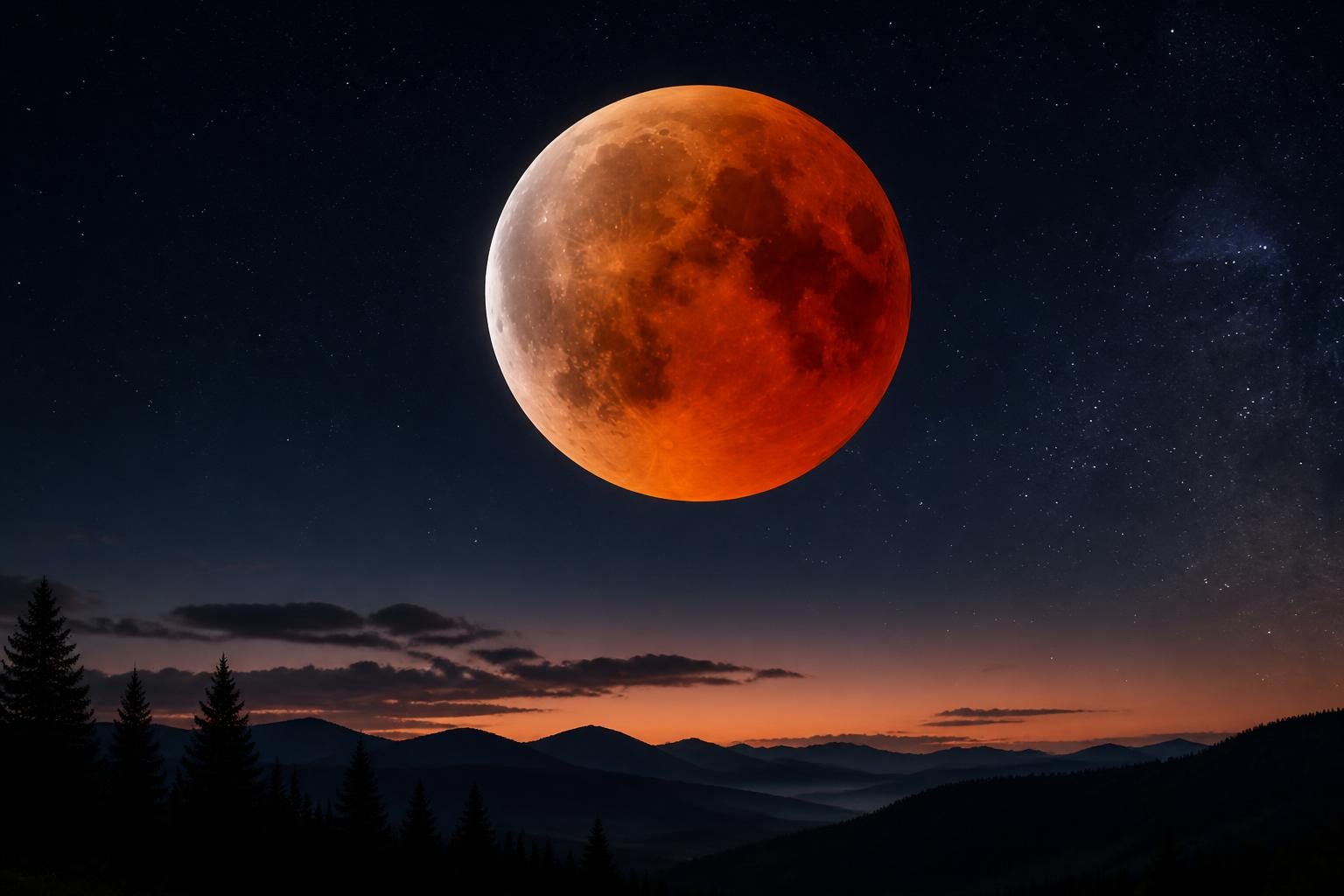
A deep partial lunar eclipse will cross the night sky over much of the United States late Thursday, Aug. 27, and early Friday, Aug. 28, 2026. At its peak, about 96% of the Moon’s disk will be inside Earth’s darkest shadow, according to NASA. The event is not a total lunar eclipse, but the portion in shadow may take on a coppery or reddish color—the reason many headlines and social posts are calling it a “blood moon.”
The eclipse is drawing attention after a busy month for skywatchers. A total solar eclipse occurred Aug. 12, and the August lunar eclipse follows during the same general eclipse season. News organizations and astronomy outlets are now publishing viewing guides, which has helped push terms such as “lunar eclipse” and “blood moon” into wider public conversation.
Here is what is confirmed, what people in the United States can expect and how to watch safely.
When the lunar eclipse will happen
The eclipse begins worldwide during the early hours of Aug. 28 in Coordinated Universal Time. In the United States, that means the main event occurs on the evening of Thursday, Aug. 27, or just after midnight on Friday, Aug. 28, depending on location.
NASA lists the peak at approximately 9:13 p.m. Pacific Daylight Time, 10:13 p.m. Mountain Daylight Time, 11:13 p.m. Central Daylight Time and 12:13 a.m. Eastern Daylight Time. The maximum occurs at 4:13 a.m. UTC on Aug. 28.
The partial phase—the point when the Moon begins entering Earth’s dark inner shadow—lasts roughly three hours and 18 minutes worldwide. The faint penumbral phase begins earlier and ends later, but it can be difficult to notice because the Moon only dims slightly.
U.S. viewing times
- Eastern time: The partial eclipse begins at about 10:34 p.m. Aug. 27, reaches its maximum at about 12:13 a.m. Aug. 28 and ends at about 1:52 a.m.
- Central time: The partial phase begins at about 9:34 p.m. Aug. 27, peaks at about 11:13 p.m. and ends at about 12:52 a.m. Aug. 28.
- Mountain time: The partial phase begins at about 8:34 p.m., peaks at about 10:13 p.m. and ends at about 11:52 p.m.
- Pacific time: The partial phase begins at about 7:34 p.m., peaks at about 9:13 p.m. and ends at about 10:52 p.m.
These times describe the eclipse globally adjusted to U.S. time zones. Local viewing can differ if the Moon is low, blocked by buildings or trees, or below the horizon. Weather will also determine whether the eclipse is visible from any particular location.
Why it is called a “blood moon”
“Blood moon” is an informal term, not a scientific classification. It is most commonly used for a total lunar eclipse, when the entire Moon passes through Earth’s umbra, or darkest central shadow. During this August event, the eclipse is partial, so only most—not all—of the lunar disk enters the umbra.
Even during a partial eclipse, the part of the Moon inside the umbra can appear orange, red or copper-colored. That light comes indirectly from sunlight passing through Earth’s atmosphere. The atmosphere scatters shorter blue wavelengths more readily, while some longer red and orange wavelengths bend into the shadow and reach the Moon.
The exact color is not guaranteed. It can vary with atmospheric conditions, including dust, smoke, clouds and other particles high above Earth. As a result, observers may see a muted orange, a deep red, a brownish shade or only a subtle change. The bright, uneclipsed portion of the Moon may also make the color harder to perceive.
What makes this eclipse unusual
This is a deep partial lunar eclipse. NASA’s visualization places about 96.3% of the Moon’s disk within the umbra at greatest eclipse. That leaves only a narrow bright section outside the darkest shadow, creating an appearance that can resemble a total eclipse without technically becoming one.
The distinction matters because eclipse types are defined by geometry, not by how dramatic the event looks. In a partial lunar eclipse, the Sun, Earth and Moon are not aligned closely enough for the Moon to pass completely through the umbra. The shadow covers most of the disk here, but a small portion remains outside it.
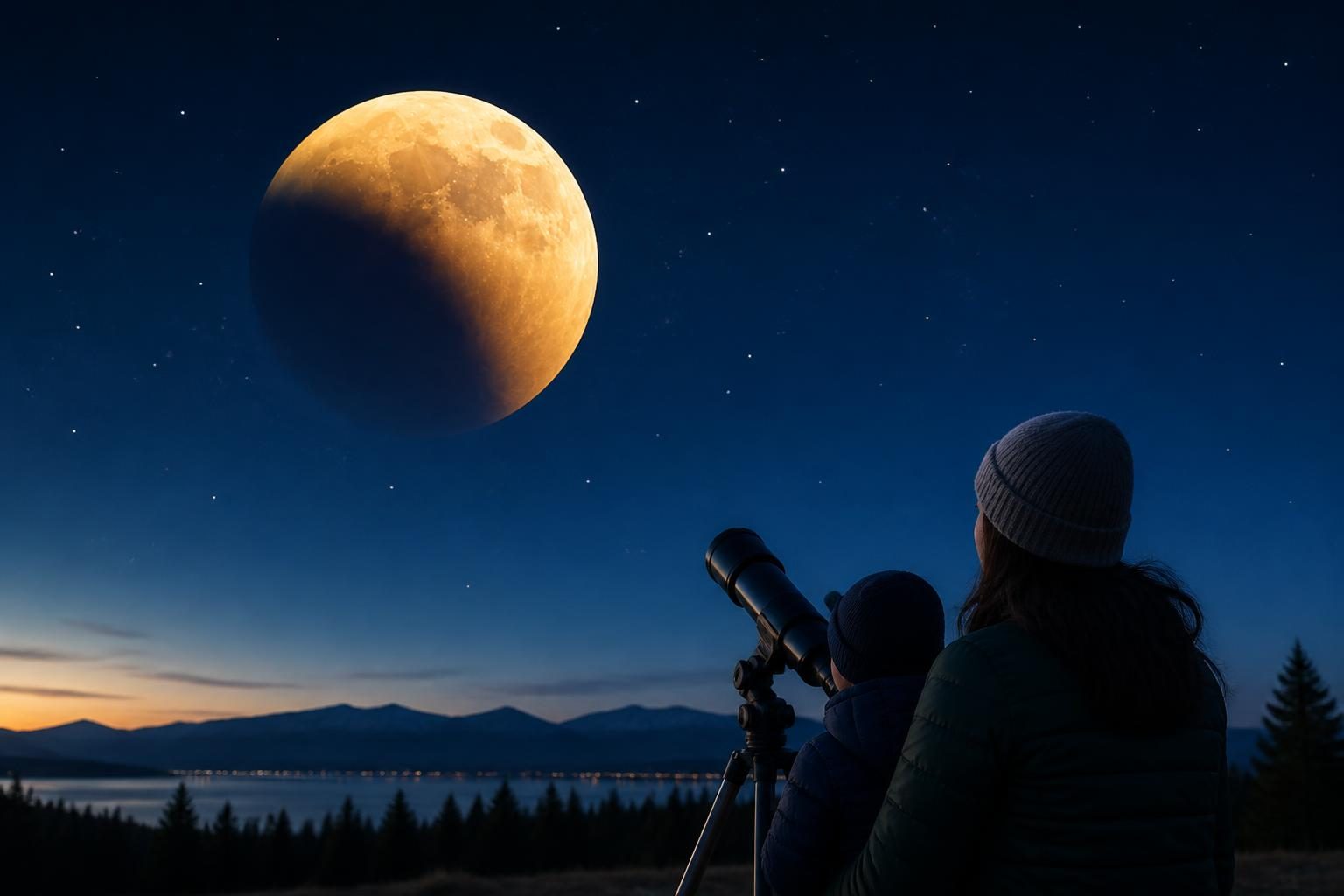
Observers may notice the Moon gradually darkening on one side before the reddish area becomes more apparent. The change is slow compared with a solar eclipse, giving viewers time to watch the shadow move across the lunar surface.
Where the eclipse will be visible
NASA says at least part of the eclipse will be visible across the Americas, Europe, Africa and parts of the Pacific region. Much of the United States is well placed to see the partial phase, although the precise experience depends on moonrise, moonset and local conditions.
Most of the contiguous United States should be able to see at least part of the main event if skies are clear. In some western locations, the Moon will be rising while the eclipse is already underway. In parts of Alaska and Hawaii, visibility is more limited or may not include the most favorable stages.
People should check a location-specific timetable rather than rely only on a national schedule. Astronomy services such as timeanddate provide local calculations, while NASA provides the event’s broader timing and visibility information.
How to watch the lunar eclipse
No special eye protection is needed for a lunar eclipse. Unlike a solar eclipse, a lunar eclipse is safe to view with the naked eye because observers are looking at sunlight reflected from the Moon, not directly at the Sun.
- Choose a location with a clear view of the Moon and as little artificial light as practical.
- Begin watching before the partial phase so you can see the shadow’s gradual approach.
- Give your eyes several minutes to adjust, especially near maximum eclipse.
- Use binoculars or a telescope if available, though neither is required.
- Check the weather forecast and confirm the Moon’s position for your specific city.
A phone can record the event, but photographing the Moon is more difficult than it appears. Automatic camera settings may render the eclipsed portion too dark or the uneclipsed portion too bright. A tripod, manual focus and several exposure settings can improve results. Viewers should avoid looking toward the Sun while waiting for the eclipse, even though the Moon itself is safe to observe.
What happens next
The eclipse will end gradually as the Moon leaves Earth’s umbra and then the penumbra. There is no physical danger or expected effect on people, animals or ordinary technology. Claims that a lunar eclipse predicts disasters or causes unusual human behavior are not supported by established astronomical evidence.
The next lunar eclipse listed by NASA is a penumbral eclipse on Feb. 20–21, 2027, which will be much subtler because the Moon will pass only through the outer portion of Earth’s shadow. A deeper lunar eclipse will eventually follow, but the timing and visibility will depend on location.
For the Aug. 27–28 event, the most useful expectation is simple: a nearly full Moon, a slowly advancing shadow and—if skies and atmospheric conditions cooperate—a narrow, warm-colored slice that may look red or copper. The event is worth watching, but “blood moon” should be understood as a popular nickname rather than a separate type of eclipse.