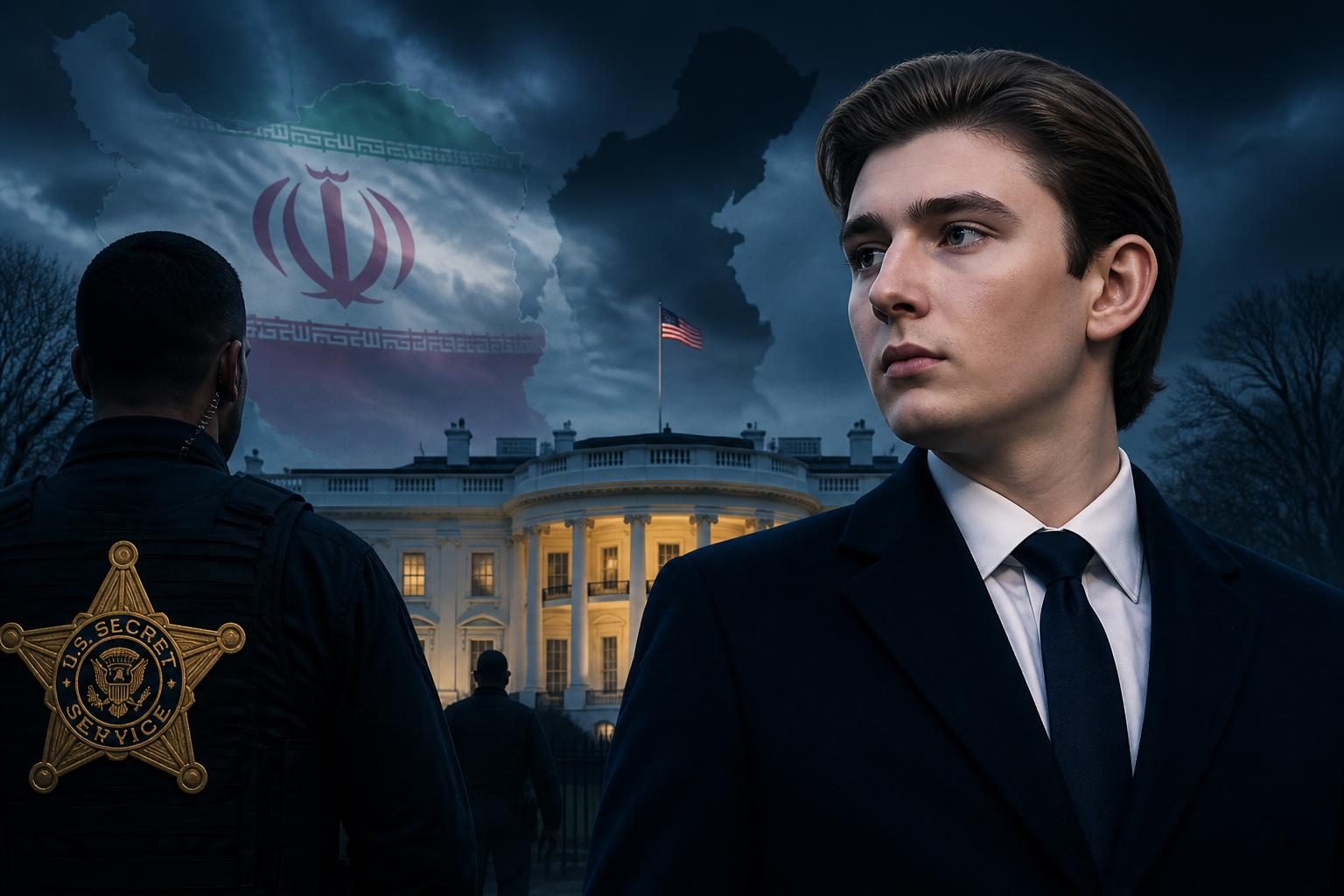
The U.S. Secret Service says it is aware of an Iranian state-media video that appears to threaten the life of Barron Trump, the youngest son of President Donald Trump. The agency said it is investigating the video as a potential threat but declined to discuss any protective measures or intelligence.
The statement, reported by ABC News, the Associated Press, Reuters and Sky News on August 25 and 26, 2026, is the verified news hook behind a surge in searches for “U.S. Secret Service” and related terms. The coverage has drawn attention because it involves a direct threat against a presidential family member and comes amid heightened tensions between the United States and Iran.
What is confirmed so far is limited: Iranian state television aired a video discussing a possible plot against Barron Trump; the Secret Service knows about it; and the agency says it investigates anything that could be perceived as a threat toward people under its protection. There has been no public confirmation that an actual attack plot was discovered, that a suspect was identified, or that the threat was assessed as credible.
What the Secret Service has said
Secret Service spokesman Nate Herring said the agency is “aware of the video” and investigates anything that can be perceived as a threat toward its protectees. He added that the agency does not discuss protective intelligence because of operational-security concerns.
That wording is significant. Being aware of a video does not, by itself, establish that the threat is imminent or credible. It indicates that the agency has identified the material and is taking it into its threat-assessment process. The public statement does not explain whether investigators have found evidence of planning, surveillance, an operational network or a specific intended location.
ABC News reported that the approximately three-minute video discussed locations where Barron Trump might be found, claimed he was being monitored and alleged that a $10 million reward had been offered for his killing. Those claims came from the Iranian broadcast and have not been independently established by U.S. authorities in the public statements reviewed for this report.
Why the story is trending
The search trend reflects several factors converging at once.
- A presidential family member is named. Threats involving a president or a close family member receive immediate attention because the Secret Service has a federal protection mission involving the president, the vice president and other designated protectees.
- The threat appeared on state media. The video was not merely an anonymous social-media post. It was broadcast by Iranian state television, making it part of a broader information and political environment, although the broadcast alone does not prove that Iranian officials ordered or operationalized an attack.
- U.S.-Iran tensions are already high. Recent reporting describes hostile rhetoric and an ongoing conflict involving the two countries. That context has increased scrutiny of statements from Iranian officials and state-affiliated outlets.
- The Secret Service response is intentionally limited. The agency’s refusal to discuss protective intelligence leaves important questions unanswered, prompting readers to search for background on what the agency does and how it evaluates threats.
Search interest should not be treated as evidence that a threat has become more serious. Google Trends measures relative search activity, not the credibility of a security warning or the likelihood of an attack.
What is known about the video
Multiple reputable outlets reported that Iranian state television aired material discussing a potential plot to assassinate Barron Trump, who is 20. The reports differ in how they characterize the video, but agree that it was presented as a threat and that the Secret Service confirmed awareness of it.
The reported $10 million reward is an allegation made in the broadcast. No U.S. government statement reviewed for this article has confirmed that a legitimate bounty exists or that money has been offered to anyone capable of carrying out an attack.
It is also not publicly clear whether the video was intended as propaganda, intimidation, a call to violence, or a reflection of an independently developed plot. Those possibilities cannot be treated as equivalent without additional evidence. The Secret Service’s investigation is intended, in part, to help determine whether the material corresponds to a real-world threat.
What “protective intelligence” means
Protective intelligence is the process of collecting, assessing and acting on information about potential threats to protected people, places and events. It can include reviewing direct threats, online material, suspicious behavior, travel information and reports from other law-enforcement or intelligence agencies.
The Secret Service’s protection work is broader than the visible agents stationed near a president. According to the agency’s public materials, its protective mission includes advance planning, venue security, threat assessment, investigations and coordination with federal, state and local partners.
Investigators generally seek to answer practical questions: Who created or distributed the threat? Is the person or group capable of acting? Is there evidence of intent, preparation or access? Is a specific target, time or location identified? Has the threat been repeated or amplified by others?
Officials often withhold details about those questions. Publicly disclosing travel patterns, protective arrangements or investigative leads could make a protectee more vulnerable. That is why statements in cases like this may confirm an investigation without describing its conclusions.
What has not been confirmed
As of August 26, 2026, public reporting and the Secret Service statement reviewed for this article do not establish several points that have circulated in online discussion.
- There is no public confirmation of an imminent attack.
- There is no public identification of a person arrested or charged in connection with the video.
- There is no public confirmation that Barron Trump was physically followed or surveilled.
- There is no public confirmation that the alleged $10 million reward is real.
- There is no public description of any change to Barron Trump’s daily routine or protection.
- There is no public finding that the Iranian government itself directed an operational assassination attempt.
These are not necessarily findings that the claims are false. They are areas where authorities have not provided publicly verifiable information.
How this fits into earlier Iran-related threats
Iran has been reported for years as a security concern for President Trump because of his decision, while president in 2020, to authorize a U.S. strike that killed Iranian Gen. Qassem Soleimani. U.S. officials and news organizations have also reported threats against Trump and members of his family.
Reuters reported that the United States received warnings from Israel over the past year about alleged Iranian intentions to assassinate Trump. Those reports, like the current video story, involve intelligence and official claims that are not fully described publicly.
The broader background matters, but it does not automatically validate every new threat or media report. Each incident must be assessed on its own evidence, including the source, specificity, intent and signs of preparation.
What happens next
The Secret Service is expected to continue reviewing the video and any related intelligence. That work could involve coordination with other U.S. agencies, foreign partners and law-enforcement authorities. If investigators identify a specific criminal threat or a person in the United States who is acting on it, additional information could emerge through an arrest, court filing or official announcement.
More commonly, the public may receive little detail. Protective investigations can conclude without a public explanation, particularly when officials determine that releasing information would compromise security or investigative methods.
Readers should be cautious with reposted clips, screenshots and claims that present the alleged bounty or surveillance as established fact. The most reliable updates will come from the Secret Service, the White House, the Justice Department or carefully sourced reporting that identifies what has been independently verified.
Bottom line
The Secret Service has confirmed awareness of an Iranian state-media video that appears to threaten Barron Trump and says it is investigating. That is the central verified fact. The video’s allegations about surveillance, a bounty and a planned assassination have not been publicly substantiated by U.S. authorities. Until officials provide more information, the responsible description is that this is a developing threat investigation—not confirmation of an attempted attack.