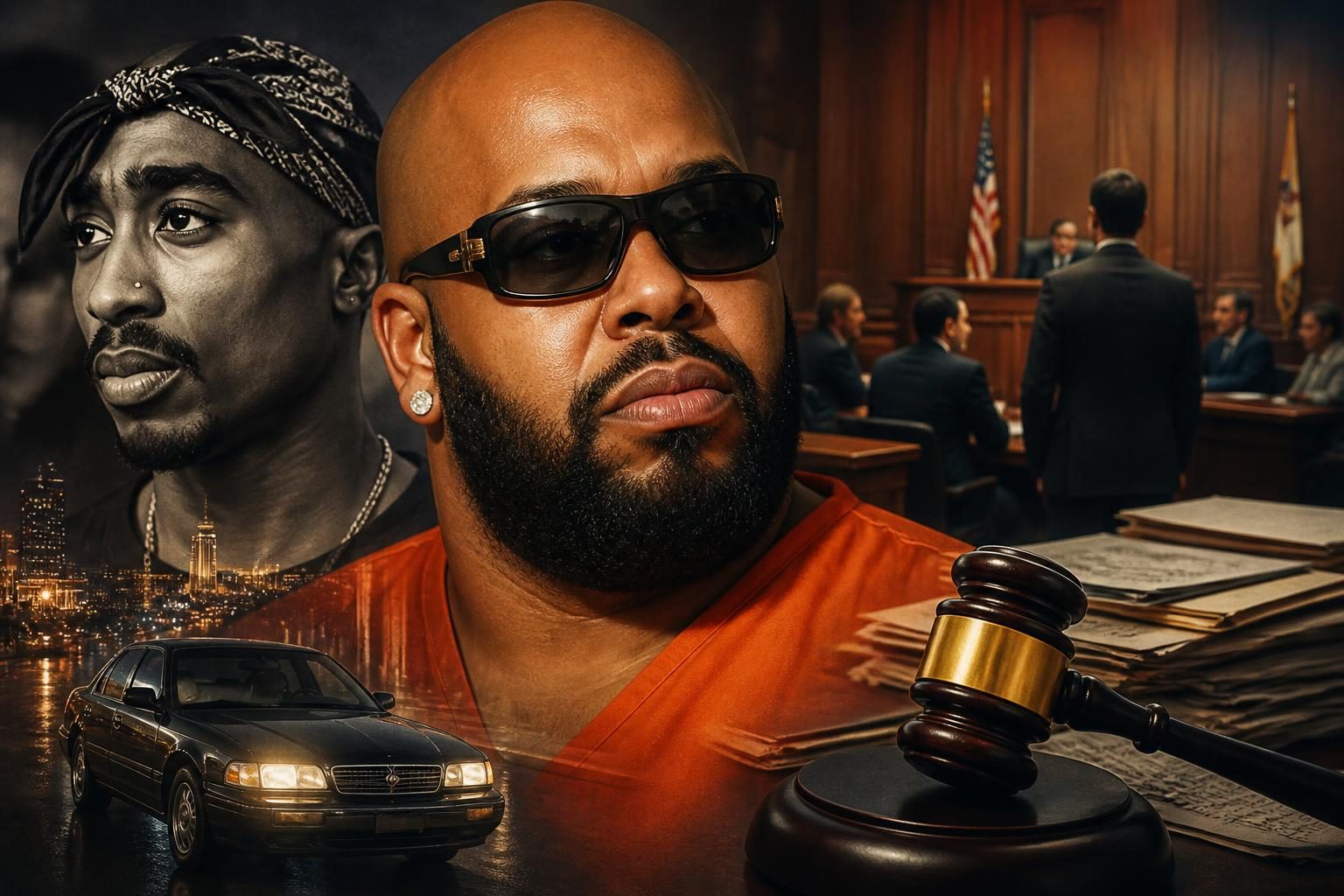
Suge Knight is trending as the long-awaited trial over Tupac Shakur’s 1996 killing gets underway in Las Vegas. Opening statements began Monday, August 17, 2026, in the case against Duane “Keffe D” Davis, a former Southern California gang leader accused of orchestrating the drive-by shooting that killed Shakur and wounded Knight.
The renewed attention does not mean Knight has been charged in Shakur’s death. Knight is a central figure in the history of the case because he was driving the BMW in which Shakur was riding when a white Cadillac pulled alongside them near the Las Vegas Strip on September 7, 1996. Knight survived the shooting, while Shakur died six days later at age 25.
The trial is one of the most closely watched criminal proceedings in hip-hop history. It also carries an important legal distinction: prosecutors are presenting allegations to a jury, not established findings of fact. Davis has pleaded not guilty, and the jury must decide whether the evidence proves his guilt beyond a reasonable doubt.
Why Suge Knight is part of the current news
Knight was in the passenger seat or driving position described in trial coverage of the BMW, depending on the specific account being summarized; established reporting consistently places him in the vehicle with Shakur when the shooting occurred. Recent coverage has focused on the possibility that testimony and other evidence could revisit what happened before, during and after the shooting.
According to prosecutors’ account, the killing followed a confrontation earlier that night at the MGM Grand involving Shakur and Orlando “Baby Lane” Anderson, Davis’ nephew and a member of the South Side Compton Crips. Prosecutors allege the shooting was an act of retaliation connected to that fight and broader tensions between rival gang affiliations surrounding the 1990s rap industry.
The prosecution’s theory is contested. Davis’ defense has argued that accounts attributed to him are unreliable, have changed over time and do not establish that he ordered the killing. Davis has publicly described being in the Cadillac from which the shots were fired, but his lawyer has said those accounts were fictionalized or embellished. The credibility of those statements is expected to be a major issue at trial.
Knight’s name is therefore trending because the trial may provide new public discussion of the night Shakur was killed, the relationship between Death Row Records and the surrounding street conflicts, and the evidence prosecutors say connects Davis to the shooting.
What happened to Tupac Shakur
Shakur and Knight were in Las Vegas on September 7, 1996, to attend a heavyweight boxing match between Mike Tyson and Bruce Seldon at the MGM Grand Garden Arena. After the fight, a confrontation broke out involving Shakur and Anderson.
Later that night, Shakur was riding in a black BMW driven by Knight. A white Cadillac pulled alongside the BMW at a traffic light, and gunfire erupted. Shakur was struck multiple times. Knight suffered a nonfatal injury from bullet fragments, according to longstanding accounts of the shooting.
Shakur was taken to a Las Vegas hospital and died on September 13, 1996. No one was charged in the killing for nearly three decades. Davis was arrested in September 2023 after a Clark County grand jury indicted him on a murder charge involving the use of a deadly weapon and a gang enhancement.
The indictment accuses Davis of obtaining and providing a gun to a person in the back seat of the Cadillac. It does not necessarily identify Davis as the person who fired the fatal shots. That distinction matters because the prosecution must prove the legal basis for Davis’ alleged role, which can include participating in or directing a killing even if prosecutors do not claim he personally pulled the trigger.
Who is Duane “Keffe D” Davis?
Davis is a former gang leader from Compton, California. He has acknowledged in interviews and in a 2019 memoir that he was in the vehicle involved in the shooting. Prosecutors say his own statements helped investigators build the case against him.
At the same time, public statements are not automatically proof of every detail they contain. The defense has pointed to differences among Davis’ accounts and has questioned whether prosecutors can corroborate them with physical evidence, witnesses or records from 1996.
Davis is the only person charged in connection with Shakur’s killing. Other people identified over the years as possible participants are dead, including Anderson, who died in 1998. The passage of time presents practical challenges for both sides, including unavailable witnesses, fading memories and evidence that may no longer exist or may be difficult to authenticate.
What is Suge Knight’s legal status?
Knight is not the defendant in the Las Vegas case. He is serving a 28-year sentence in California after pleading no contest in 2018 to voluntary manslaughter in the 2015 death of Terry Carter, a businessman who was struck by Knight’s pickup truck in a Compton parking lot. The sentence also reflected prior criminal convictions and related enhancements.
That conviction is separate from the Tupac Shakur case. Knight has not been convicted of involvement in Shakur’s murder, and current trial coverage should not be read as a new criminal charge against him.
Knight’s legal status may still affect the trial because the defense has previously indicated that it could seek his testimony. Whether he testifies, what questions he may be permitted to answer and how the court handles any claims about his memory or credibility are matters for the judge and lawyers in the case.
What prosecutors must prove
To obtain a murder conviction, prosecutors must satisfy the jury that Davis committed the charged offense under Nevada law. In practical terms, that means presenting evidence strong enough to establish guilt beyond a reasonable doubt, rather than merely showing that Davis knew the people involved or was present in Las Vegas.
Prosecutors are expected to rely on a combination of Davis’ public and recorded statements, testimony about the confrontation at the MGM Grand, evidence concerning the vehicles and participants, and testimony from investigators or other witnesses. The strength and admissibility of each piece of evidence will be tested in court.
The defense is expected to challenge the reliability of Davis’ statements and argue that the state lacks key corroborating evidence, such as the murder weapon or the vehicle used in the shooting. The absence of a particular item does not by itself decide a criminal case, but it can become important when jurors evaluate whether the remaining evidence is reliable.
Why the case still draws intense interest
Shakur’s death has remained a defining unsolved mystery in popular culture because of his influence, the public feud between major rap camps in the 1990s and the lack of an arrest for almost 30 years. Knight, as the co-founder of Death Row Records and the person with Shakur during the shooting, has been part of that public narrative from the beginning.
Death Row Records helped shape the commercial sound and image of West Coast hip-hop. Knight’s business relationship with Shakur placed him near one of the era’s most consequential music-industry conflicts. But cultural prominence and proximity to an event are not the same as criminal responsibility. Those questions must be separated from speculation that has circulated for years.
The case also reflects how cold-case investigations can develop long after an event. Investigators have revisited old interviews, memoirs and other records, while prosecutors must still meet modern courtroom standards for admissible evidence. A trial can clarify some disputed facts, but it may not resolve every unanswered question about the shooting.
What happens next
The trial will proceed through witness testimony, documentary and physical evidence, legal arguments and cross-examination. The judge will rule on objections and decide which evidence the jury may consider. After both sides present their cases, attorneys will deliver closing arguments and the jury will deliberate.
The timing of a verdict cannot be predicted reliably. Trials can last days or weeks depending on the number of witnesses, legal disputes and the complexity of the evidence.
Until the jury reaches a verdict, the most accurate description is that Davis is accused of orchestrating Shakur’s killing. Knight remains a witness or potential witness in the broader story, not a defendant in the case currently before the court.
What is confirmed — and what remains disputed
- Confirmed: Tupac Shakur was shot in Las Vegas on September 7, 1996, while riding in a BMW with Suge Knight.
- Confirmed: Shakur died in a Las Vegas hospital on September 13, 1996, at age 25.
- Confirmed: Duane “Keffe D” Davis was indicted in 2023 and has pleaded not guilty.
- Confirmed: Davis’ trial began with jury proceedings and opening statements in August 2026.
- Disputed: Whether Davis directed the shooting, how reliable his public accounts are and what evidence independently corroborates them.
- Not established: Any claim that Suge Knight was responsible for Shakur’s murder. Knight is not charged in the current case.
The central question now is narrower than many years of online speculation: whether prosecutors can prove their case against Davis in court. The jury, not public attention surrounding Knight or Shakur’s legacy, will determine the outcome.